
SSC exams are the front door to hundreds of central government jobs, and yet most first-time aspirants walk in with half the picture. They know the letters CGL or CHSL, they’ve heard a cousin got “selected through SSC”, and that’s about it. Which exam fits their qualification? How many stages are there? What does the job actually pay? Those answers are scattered across notifications, coaching videos and forums that sometimes contradict each other.
SSC recruitment process questions get easier once you see the whole system on one page. This guide walks through what the Staff Selection Commission is, which exams it runs, who can apply, what the posts and pay levels look like, and how an application travels from notification to joining letter. It uses plain language and a lot of tables, so you can find your own exam quickly and skip the rest.
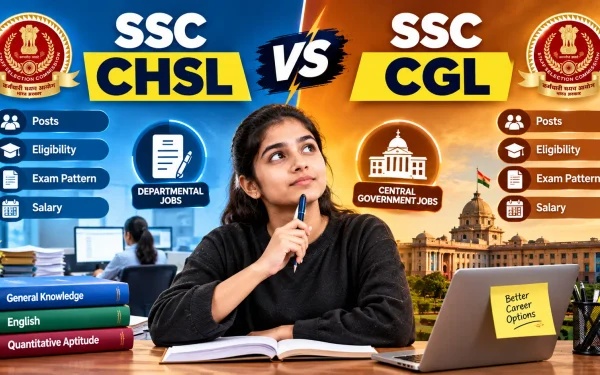
Among the major SSC examinations, CHSL and CGL differ in educational eligibility, job profiles and career progression. Read our detailed guide to SSC CHSL vs SSC CGL: what’s the difference for a direct comparison of both exams.
What Is SSC? The Staff Selection Commission in Plain Words
SSC stands for Staff Selection Commission, a central government body that recruits candidates for Group B (non-gazetted) and Group C posts in ministries, departments and offices of the Government of India. It works under the Department of Personnel and Training and is headquartered in New Delhi, with regional offices across the country that handle examination centres and local coordination.
The commission began life in 1975 as the Subordinate Services Commission and took its present name in 1977. Today it conducts large computer-based tests every year, and a single notification can attract applications from several lakh candidates. SSC doesn’t hire for state government jobs, so if a state post is what you want, you’ll be looking at a state public service commission instead.
SSC at a Glance
| Detail | Information |
|---|---|
| Full Form | Staff Selection Commission |
| Parent Department | Department of Personnel and Training (DoPT) |
| Headquarters | New Delhi |
| Recruits For | Group B (non-gazetted) and Group C central government posts |
| Main Mode of Exam | Computer-based test (CBT) |
| Official Website | ssc.gov.in |
SSC Exams List: The Main Examinations at a Glance
SSC exams fall into a handful of families, and the quickest way to sort them is by the qualification you hold. Matriculation pass candidates look at MTS and GD Constable. Class 12 pass candidates look at CHSL and Stenographer. Graduates look at CGL and CPO. Diploma and degree holders in engineering look at Junior Engineer.
Major SSC Exams and Who They’re For
| Exam | Minimum Qualification | Typical Posts |
|---|---|---|
| SSC MTS & Havaldar | Class 10 pass | Multi-Tasking Staff, Havaldar (CBIC and CBN) |
| SSC GD Constable | Class 10 pass | Constable (GD) in CAPFs, NIA, SSF and Rifleman (GD) in Assam Rifles |
| SSC CHSL | Class 12 pass | LDC/JSA, Postal/Sorting Assistant, Data Entry Operator |
| SSC Stenographer (Grade C and D) | Class 12 pass | Stenographer in ministries and departments |
| SSC CGL | Graduation | Inspector, Assistant Section Officer, Auditor, Tax Assistant and similar |
| SSC CPO | Graduation | Sub-Inspector in Delhi Police and CAPFs, ASI in CISF |
| SSC JE | Diploma or degree in engineering | Junior Engineer (civil, mechanical, electrical) |
| SSC Selection Post | Varies by phase (10th, 12th or graduation) | Assorted posts in central offices |
| SSC Junior Hindi Translator | Master’s with Hindi/English and translation background | Junior Hindi Translator and similar |
SSC Eligibility: The Basics Every Applicant Should Check
SSC eligibility has three parts that apply to almost every exam: nationality, age and educational qualification. Beyond that, physical standards matter for uniformed posts, and some posts add extra conditions such as a particular subject at the Class 12 level.
On nationality, candidates are generally required to be Indian citizens, with limited exceptions for certain categories as specified in each notification. On education, you need the minimum qualification on or before the cut-off date given in the notification, though many exams allow final-year students to apply on the condition that they produce their certificate by the stated date.
Eligibility requirements differ across SSC examinations, including educational qualifications, age limits and applicable age relaxations. For candidates considering the Combined Higher Secondary Level examination, our guide to SSC eligibility, age limit and educational qualification explains the specific requirements for different posts.
General SSC Eligibility Criteria
| Criterion | What to Check |
|---|---|
| Nationality | Indian citizen, with limited exceptions listed in the notification |
| Educational Qualification | Must hold the required qualification by the cut-off date |
| Age | Falls within the limits for that exam, with relaxations where applicable |
| Physical Standards | Required for GD Constable, CPO and some MTS/Havaldar posts |
| Documents | Valid ID, certificates, category/PwBD proof where claimed |
SSC Age Limit and Relaxation: Why the Numbers Differ So Much
SSC age limit is where aspirants most often slip up, because it changes from exam to exam and sometimes from post to post within the same exam. As a rough guide, CHSL has recently been set at 18 to 27 years, while GD Constable is usually in the early twenties, and CGL offers different upper limits depending on the post. Always read the age cut-off date in the current notification, since the limit is counted as of that specific date.
Age relaxation follows government rules. As a general guide, SC and ST candidates receive 5 years, OBC candidates 3 years, and persons with benchmark disabilities 10 years or more depending on their category, while ex-servicemen get relaxation as per the applicable norms.
Typical Age Limits (Indicative Only)
| Exam | Typical Age Range | Note |
|---|---|---|
| SSC MTS | Around 18 to 25 (some posts 18 to 27) | Varies by post and year |
| SSC GD Constable | Around 18 to 23 | Relaxation applies as per rules |
| SSC CHSL | 18 to 27 | Matches the 2026 CHSL notification |
| SSC CGL | 18 to 27, up to 30 or 32 for certain posts | Depends on the post |
| SSC CPO | Around 20 to 25 | For Sub-Inspector posts |
| SSC JE | Up to about 30 | Varies by department |
Standard Age Relaxation
| Category | Relaxation |
|---|---|
| SC / ST | 5 years |
| OBC | 3 years |
| PwBD (Unreserved) | 10 years |
| Ex-Servicemen | As per applicable rules |
SSC Posts: What You Actually Do After Selection
SSC posts vary a lot in daily work, even within one exam. A CHSL clerk handles file movement, correspondence and data entry in an office. A CGL Inspector may work in income tax, central excise or customs, dealing with enforcement and assessment. A GD Constable serves in a central armed police force, with postings that can include border areas. Knowing the nature of the work matters, because the lifestyle differs more than the salary does.
Common SSC Posts by Exam
| Exam | Example Posts | Nature of Work |
|---|---|---|
| CGL | Inspector, Assistant Section Officer, Auditor, Tax Assistant | Administrative, audit and enforcement roles |
| CHSL | LDC/JSA, Postal Assistant, DEO | Clerical and data-handling work |
| MTS | Multi-Tasking Staff, Havaldar | Support and field duties |
| GD Constable | Constable in CAPFs, NIA, SSF; Rifleman in Assam Rifles | Uniformed security duties |
| CPO | Sub-Inspector, ASI | Police and paramilitary leadership roles |
| JE | Junior Engineer | Technical work in civil, mechanical or electrical departments |
SSC Pay Level: What the Salary Structure Looks Like
SSC pay level follows the 7th Central Pay Commission matrix, where each post is placed on a numbered level with a basic pay range. These ranges are fixed in the notification, but your actual in-hand salary also depends on allowances such as Dearness Allowance and House Rent Allowance, which change with your posting city.
Indicative Pay Levels (7th CPC)
| Post Group | Pay Level | Basic Pay Range |
|---|---|---|
| MTS / Havaldar | Level 1 | ₹18,000 – ₹56,900 |
| LDC / JSA | Level 2 | ₹19,900 – ₹63,200 |
| Constable (GD) | Level 3 | ₹21,700 – ₹69,100 |
| DEO / Tax Assistant type posts | Level 4 | ₹25,500 – ₹81,100 |
| Auditor / Higher DEO type posts | Level 5 | ₹29,200 – ₹92,300 |
| Sub-Inspector / Junior Engineer | Level 6 | ₹35,400 – ₹1,12,400 |
| Inspector / Assistant Section Officer type posts | Level 7 | ₹44,900 – ₹1,42,400 |
These ranges are indicative. The exact pay level for each post is stated in that year’s notification, so check it before you decide.
SSC Recruitment Process: From Notification to Joining Letter
SSC recruitment process looks long on paper, but it follows the same basic path for almost every exam. First comes the notification, which lists posts, eligibility, dates and fees. You then register on the SSC portal using One-Time Registration, fill the online application for the specific exam, upload your photograph and signature, and pay the fee, which is generally ₹100 for the general category, with exemptions for women, SC, ST, PwBD and ex-servicemen candidates.
After applications close, SSC usually opens a short correction window, and then releases admit cards and city intimation slips before the exam. If you clear the written stages, you move on to whatever extra tests the post needs, then document verification, and finally the allocation of posts and departments based on your rank and preference.
Step-by-Step: How an SSC Application Moves Forward
| Step | Stage | What Happens |
|---|---|---|
| 1 | Notification | SSC publishes posts, eligibility, dates and fees |
| 2 | One-Time Registration | You create your profile on the SSC portal |
| 3 | Online Application | Fill the exam form, upload documents, pay the fee |
| 4 | Correction Window | Short period to fix certain errors |
| 5 | Admit Card | Exam city, date and shift are released |
| 6 | Written Exam (CBT) | Tier-I, and Tier-II where applicable |
| 7 | Skill / Physical Tests | Typing, data entry, PET/PST or medical, depending on post |
| 8 | Document Verification | Certificates and category proofs are checked |
| 9 | Final Merit and Allocation | Posts and departments assigned by rank and choice |
SSC Selection Process: How It Differs From Exam to Exam
SSC selection process isn’t identical across exams, and mixing them up is a common mistake. CGL and CHSL both use a Tier-I and Tier-II structure, with additional skill or typing tests for certain posts. GD Constable and CPO add physical standard and endurance tests, plus a medical examination. MTS and Stenographer have their own combinations again. Most SSC exams don’t involve a personal interview, so the written test and the follow-up stages carry the weight.
Negative marking is standard in the computer-based tests, but the penalty depends on the exam and tier. For example, CHSL Tier-I deducts 0.50 marks for every wrong answer, and CGL Tier-I uses the same deduction. Check the current notification for the exact scheme before you decide how aggressively to attempt questions.
Selection Stages by Exam
| Exam | Written Stage(s) | Additional Stage(s) |
|---|---|---|
| CGL | Tier-I, Tier-II | Skill/computer test for certain posts, document verification |
| CHSL | Tier-I, Tier-II | Skill or typing test depending on post, document verification |
| MTS | CBT | Physical tests for some Havaldar posts, document verification |
| GD Constable | CBT | Physical efficiency and standard tests, medical, document verification |
| CPO | Paper-I, Paper-II | Physical tests, medical, document verification |
| Stenographer | CBT | Skill test, document verification |
| JE | Paper-I, Paper-II | Document verification |
SSC Exam Calendar 2026-27: Reading the Dates the Right Way
SSC exam calendar 2026-27 was published at the start of the year, and SSC has since revised parts of it, which is why different websites show different dates for the same exam. The sensible approach is to treat the calendar as a tentative guide to the season in which each exam is likely to appear, and to rely on the official notification and ssc.gov.in for exact dates.
Some things are clear. The CHSL 2026 notification opened on September 7, 2026, with the online application running until October 7. The GD Constable 2027 notification has been expected around the autumn of 2026, with the exam tentatively in early 2027. Other exams, including MTS and CPO, have had windows spread across mid-to-late 2026.
Tentative Cycle (Verify on the Official Site)
| Exam | Typical Position in the Cycle |
|---|---|
| CGL | Notified in spring, with exam stages later in the year |
| CHSL | Notification opened September 7, 2026 |
| MTS & Havaldar | Notification mid-to-late 2026, exam in the second half of the year |
| CPO | Exam window around late 2026 |
| GD Constable (2027) | Notification around autumn 2026, exam tentatively early 2027 |
If you applied for the CHSL 2026 recruitment, the notification also lists a short correction window in mid-October, so check the official site promptly for the current status.
Which SSC Exam Is Right for You?
SSC CGL, CHSL, MTS and the rest overlap just enough to be confusing, so choosing by qualification and goal helps. Graduates who want office, audit or enforcement roles usually aim for CGL. Class 12 pass candidates who prefer clerical or data-based work look at CHSL. Candidates who want a uniformed career look at GD Constable or CPO. And matriculation pass candidates who want the earliest entry point look at MTS.
Quick Chooser
| Your Situation | Exams to Consider |
|---|---|
| Class 10 pass, want an office or support role | SSC MTS |
| Class 10 pass, want a uniformed career | SSC GD Constable |
| Class 12 pass, want clerical or data work | SSC CHSL, Stenographer |
| Graduate, want administrative or tax roles | SSC CGL |
| Graduate, want police or paramilitary leadership | SSC CPO |
| Engineering diploma or degree | SSC JE |
Common Mistakes Aspirants Make With SSC Exams
SSC eligibility and paperwork errors cost more candidates their seats than weak preparation does. Many people lose out through avoidable slips that have nothing to do with how much they studied.
Mistakes to Avoid
| Mistake | Why It Hurts | Fix |
|---|---|---|
| Ignoring the age cut-off date | Application rejected later | Calculate your age as of the notification date |
| Applying at the last minute | Portal slowdowns and failed payments | Apply a few days early |
| Wrong category or PwBD documents | Disqualification at verification | Keep certificates ready and valid |
| Mixing up exam patterns | Wasted preparation time | Study the current notification and pattern |
| Relying on unofficial dates | Missing deadlines | Check ssc.gov.in regularly |
Frequently Asked Questions About SSC Exams
1. What is the full form of SSC?
SSC stands for Staff Selection Commission, the central government body that recruits for Group B (non-gazetted) and Group C posts in the Government of India.
2. Which SSC exam is best after Class 12?
SSC CHSL and the Stenographer exams are the main options for Class 12 pass candidates, with CHSL covering clerical and data-entry posts.
3. Can I apply for more than one SSC exam in the same year?
Yes. You can apply for every exam you’re eligible for, since each one has its own notification, application and exam schedule.
4. Is there a limit on the number of attempts?
SSC generally doesn’t set a fixed number of attempts. The age limit is what effectively decides how long you can keep trying.
5. Do SSC exams have an interview?
Most SSC exams, including CGL and CHSL, don’t have a personal interview. Selection rests on the written tests and any skill, physical or medical stages for the post.
6. Is negative marking applicable in SSC exams?
Yes, in most computer-based tests. The penalty varies by exam and tier, for example 0.50 marks per wrong answer in CHSL Tier-I.
7. How do I apply for an SSC exam?
Register on the SSC portal through One-Time Registration, fill the online application for the exam, upload your photograph and signature, and pay the fee when the notification is open.
8. What is the application fee for SSC exams?
It is generally ₹100 for the general category, with exemptions for women, SC, ST, PwBD and ex-servicemen candidates, though you should confirm in each notification.
9. Which SSC exam has the highest salary?
Salary depends on the post’s pay level. Graduate-level posts through CGL and CPO usually sit higher on the pay matrix than posts filled through MTS or CHSL.
10. Are SSC exam dates fixed?
No. The yearly calendar is tentative and SSC has revised parts of the 2026-27 schedule, so rely on the official notification and ssc.gov.in for exact dates.
11. Do SSC jobs offer allowances and benefits beyond basic pay?
Yes. Selected candidates receive allowances such as Dearness Allowance and House Rent Allowance, along with standard central government benefits, as described in each recruitment notification.