
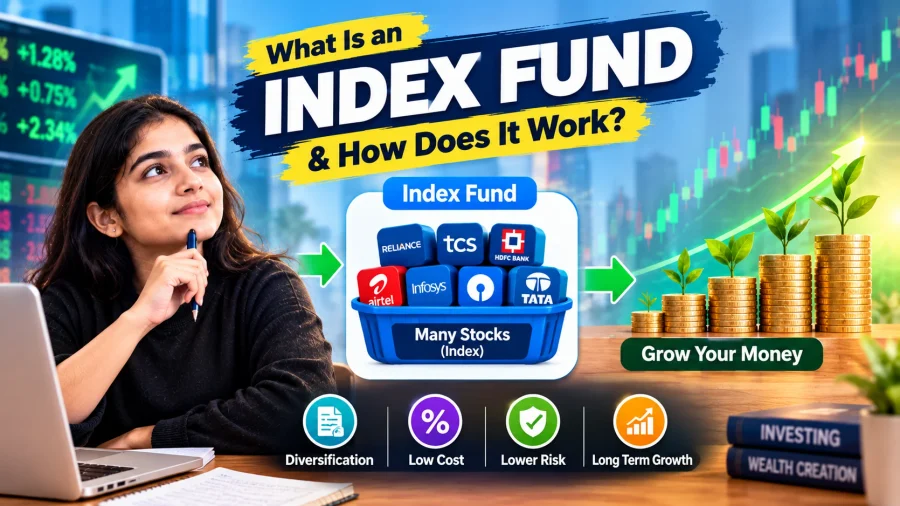

What is an index fund is a question that tends to come up right after someone realises that picking individual stocks is harder than it looks. You read about a hot tip, buy in, watch it wobble, and start wondering whether there’s a calmer way to take part in the market. An index fund is that calmer way: no stock-picking, no guessing which fund manager will shine next year, just a simple promise to copy a market index as closely as possible.
Index fund India searches have climbed steadily as more first-time investors start SIPs, and the questions are always similar. How does it work? Which one is best? Is it better than an ETF or a normal mutual fund? Can it really get me to ₹1 crore? This guide answers all of that in plain language, with tables, honest limits and worked examples. Nothing here is a recommendation to buy a particular fund, because the right choice depends on your goals, your time horizon and how you’d react to a 30% fall.
What Is an Index Fund? The Simple Definition
What is an index fund in one line: it’s a mutual fund that doesn’t try to beat the market, it tries to match it. A market index, such as the Nifty 50 or the Sensex, is a list of companies used to measure how a slice of the market is doing. An index fund buys the same companies, in roughly the same proportions, so its performance follows the index up and down.
Because the fund simply copies a published list, nobody has to research stocks or predict winners. That’s why index funds are called passive funds, and why they usually cost much less than actively managed funds, where a manager and a research team are paid to try to outperform. The idea goes back to 1976, when John Bogle launched the first index fund for ordinary investors in the United States, and it has spread across the world since.
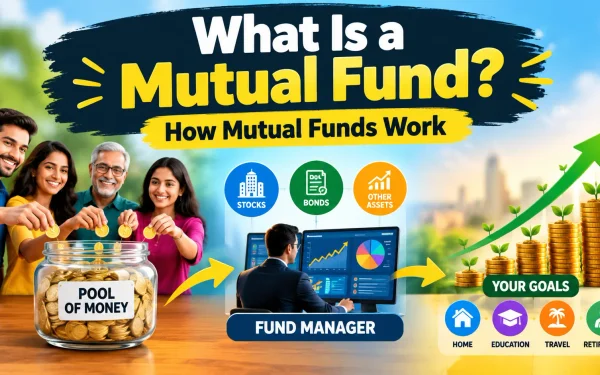
An index fund is one type of mutual fund, but not every mutual fund follows an index. If you’re new to investing, read our guide to what a mutual fund is and how mutual funds work to understand how pooled investments, fund managers and NAV fit together.
Index Fund Basics
| Term | Meaning |
|---|---|
| Index | A basket of stocks that measures part of the market, such as the Nifty 50 |
| Index fund | A mutual fund that copies an index |
| Passive investing | Following an index instead of trying to beat it |
| Active fund | A fund where a manager picks stocks hoping to outperform |
| Tracking error | The gap between the fund’s returns and the index’s returns |
Index Fund India: How the Market Looks Here
Index fund India options are regulated by SEBI like any other mutual fund, and they’re sold by asset management companies in the same way as other schemes. You buy units at the day’s NAV, you can invest through a lump sum or a SIP, and you can redeem when you choose, subject to the scheme’s rules. Many index funds let you start a SIP with a few hundred rupees.
Over the last several years, more fund houses have launched index funds across different indices, so investors now have a wide menu, from large-cap benchmarks to mid-cap, broader-market and sector-style indices. The abundance is useful, but it also makes it easy to over-complicate something that is meant to be simple.
How Index Funds Work: What Happens Behind the Scenes
How index funds work is much less mysterious than it sounds. The index provider publishes a list of stocks and the weight each one carries. The fund manager buys those stocks in the same proportions using investor money. When the index changes, for example when a company is added or removed during a periodic review, the fund trades to match the new list.
Your units grow or shrink with the index, minus the fund’s small annual fee, called the expense ratio. There’s no stock-picking decision to make, so the main things that can separate one index fund from another tracking the same index are its costs and how closely it follows the index.
How an Index Fund Operates
| Step | What Happens |
|---|---|
| 1 | An index is chosen, for example the Nifty 50 |
| 2 | Investors put money into the fund |
| 3 | The fund buys the index’s stocks in matching proportions |
| 4 | The index is reviewed periodically and the fund adjusts to match |
| 5 | Fund value moves with the index, minus the expense ratio |
| 6 | Investors redeem units at the NAV |
Index Funds Nifty 50: The Most Popular Starting Point
Index funds Nifty 50 are the most widely used index funds in India. The Nifty 50 is an index of 50 large companies listed on the National Stock Exchange, chosen by size and trading activity and spread across sectors. NSE reviews the index twice a year, so companies can enter or leave as the market changes.
One thing worth knowing is that the Nifty 50 isn’t equally spread. Bigger companies carry bigger weights, and financial services typically make up the largest sector share, with other heavy sectors including information technology and energy. So a Nifty 50 index fund gives you broad large-company exposure, but not perfectly balanced exposure across every part of the economy.
Nifty 50 Index Fund: What You’re Buying
| Feature | Detail |
|---|---|
| Index Provider | NSE Indices |
| Number of Stocks | 50 large companies |
| Weighting | Larger companies carry larger weights |
| Review Frequency | Twice a year |
| Typical Sector Tilt | Financial services is usually the largest weight |
| Risk Level | Equity market risk; can fall sharply in the short term |
Index Funds List: The Main Types You’ll See
Index funds list pages can feel overwhelming, but most funds fall into a handful of families depending on which index they copy. Large-cap index funds track the biggest companies. Mid-cap and small-cap index funds track smaller companies, which can offer higher growth potential with sharper swings. Broad-market index funds spread across hundreds of companies, and some index funds follow specific themes or factors.
Common Types of Index Funds in India
| Type | What It Tracks | Typical Character |
|---|---|---|
| Large-cap index funds | Nifty 50, Sensex | Steadier, tracks big companies |
| Large-cap extension funds | Nifty Next 50 | Next tier of large companies, usually more volatile |
| Mid-cap index funds | Nifty Midcap indices | Higher growth potential, bigger swings |
| Broad-market index funds | Nifty 500 and similar | Wider spread across market segments |
| Factor or theme index funds | Value, momentum, quality themes | More specialised, not a first choice for beginners |
Top Index Funds India: How to Compare Them Properly
Top index funds India is one of the most searched phrases in this space, and the honest answer is that there’s no permanent, objective top five. Funds that track the same index hold the same stocks, so their returns are usually almost identical. What differs is cost, tracking error and size, and rankings on the internet change from site to site and month to month.
Well-known Nifty 50 index funds in India are offered by fund houses such as Bandhan, DSP, HDFC, HSBC, ICICI Prudential, Kotak, Motilal Oswal, Navi, Nippon India, SBI, Tata and UTI. That list is in alphabetical order, it’s not a ranking and it isn’t a recommendation. Published expense ratios for the same fund also differ between comparison sites, depending on the date and the plan, so always check the current figure in the fund’s official factsheet.
How to Compare Index Funds
| Factor | What to Look For | Why It Matters |
|---|---|---|
| Expense ratio | Lower is generally better, compare Direct plans | Fees reduce returns every year |
| Tracking error | Smaller is better | Shows how closely the fund follows the index |
| Fund size (AUM) | Reasonable and stable | Very tiny funds can be less efficient |
| Index tracked | Matches your goal | Nifty 50 vs mid-cap is a big difference in risk |
| Exit load | Check if any applies | Can cost you if you leave early |
Which Index Fund Is the Best?
Index fund India investors often want a single winner, but with funds tracking the same index there isn’t a reliably “best” one. If two funds copy the Nifty 50, the one with lower costs and a very small tracking error will usually deliver slightly better results over time. The gap can be small year to year but it compounds.
A practical way to choose is to decide the index first, then compare a few funds on expense ratio, tracking error and fund size, and pick a Direct plan from a fund house you’re comfortable with. Choosing the right index for your risk level matters far more than squeezing out the last hundredth of a percent in costs.
Index Funds vs Mutual Funds: Is There a Difference?
Index funds vs mutual funds is a slightly misleading comparison, because an index fund is a type of mutual fund. The real contrast is between passive index funds and actively managed mutual funds. Both are bought and redeemed in the same way, but they differ in strategy and cost.
Active funds try to beat the market, and a manager decides which stocks to hold. That can pay off, but it isn’t guaranteed, and the extra research costs money, which shows up as a higher expense ratio. Index funds don’t try to win, they aim to match, which keeps costs low and removes the risk of picking the wrong manager, though it also means you’ll never beat the market.
Index Funds vs Actively Managed Mutual Funds
| Aspect | Index Fund | Actively Managed Fund |
|---|---|---|
| Goal | Match the index | Beat the index |
| Stock selection | Follows the index list | Manager decides |
| Typical costs | Lower | Higher |
| Chance of beating the market | Not the aim | Possible but not guaranteed |
| Manager risk | Very low | Higher |
| Beginner-friendliness | High | Depends on the fund |
Index Funds vs ETF: Which One Suits You?
Index funds vs ETF is another common head-scratcher, since both usually track the same indices. The difference is how you buy them. An index fund is bought from the fund house at the day’s NAV, and it works smoothly with SIPs. An ETF trades on the stock exchange at a live price during market hours, and you need a demat and trading account.
ETFs can have very low costs, but they come with extra things to watch, such as the gap between buying and selling prices and how well the ETF’s market price tracks its underlying value. For many beginners, an index fund’s automatic SIPs and simplicity make it easier to stick with, while ETFs suit people who are comfortable using a trading platform.
Index Fund vs ETF
| Aspect | Index Fund | ETF |
|---|---|---|
| Where you buy | From the fund house or an investing platform | On the stock exchange |
| Pricing | One NAV per day | Live price through the day |
| Account needed | Mutual fund account | Demat and trading account |
| SIP convenience | Very easy | Usually manual |
| Extra things to watch | Expense ratio, tracking error | Expense ratio, tracking error, buy-sell spread |
How to Invest in Index Funds India: A Beginner’s Walkthrough
How to invest in index funds India takes less time than most people expect. You complete KYC once using your PAN and address proof, choose a platform, pick an index, compare a few funds, and start a SIP or lump sum. After that, the best habit is to leave the investment alone and review it once or twice a year.
Steps to Start
| Step | Action |
|---|---|
| 1 | Decide your goal and how long you can stay invested |
| 2 | Complete KYC with PAN and ID proof |
| 3 | Choose a platform: an AMC site or an investing app |
| 4 | Pick an index that matches your risk level |
| 5 | Compare expense ratio, tracking error and fund size |
| 6 | Choose a Direct plan if you’re investing on your own |
| 7 | Start a SIP or a lump sum |
| 8 | Review once or twice a year, not every day |
Index Funds Calculator: How the Numbers Work
Index funds calculator tools are simply SIP or lump-sum calculators, and you can understand them without using one. For a SIP, the future value is the monthly amount multiplied by a growth factor based on the assumed return and the number of months. The formula is FV = P × [((1 + i)^n − 1) / i] × (1 + i), where P is the monthly amount, i is the monthly rate and n is the number of months.
The results below are illustrations built on assumed yearly returns, not predictions. Real returns are uneven, can be lower than these and can be negative in some years.
Illustration: ₹10,000 Monthly SIP (Assumed Returns, Not a Promise)
| Assumed Annual Return | After 10 Years (Invested ₹12 Lakh) | After 15 Years | After 20 Years (Invested ₹24 Lakh) |
|---|---|---|---|
| 10% | about ₹20.7 lakh | about ₹41.8 lakh | about ₹76.6 lakh |
Illustration: ₹5,000 Monthly SIP for 10 Years (Assumed Returns)
| Assumed Annual Return | Approximate Value |
|---|---|
| 8% | about ₹9.2 lakh |
| 10% | about ₹10.3 lakh |
| 12% | about ₹11.6 lakh |
How Can I Make ₹1 Crore in 10 Years?
Index fund SIPs can work toward ₹1 crore, but the numbers are demanding and it’s better to see them than to be sold a dream. If the market delivers an assumed 12% a year, you’d need to invest about ₹43,000 every month for ten years. At an assumed 10%, it’s about ₹48,400 a month, and at 8%, about ₹54,300. Those are large monthly amounts for most households.
Two things make the target easier. A step-up SIP, where you raise your monthly amount by 10% each year, lowers the starting figure to roughly ₹29,600 a month at an assumed 12%, ₹32,800 at 10% and ₹36,300 at 8%. And a longer time frame helps a great deal, because compounding does more work in later years. If you already have a lump sum, about ₹32 lakh today would grow to ₹1 crore in ten years at an assumed 12%, or about ₹38.6 lakh at 10%.
Illustration: What It Takes to Reach ₹1 Crore in 10 Years
| Assumed Annual Return | Flat Monthly SIP Needed | Starting SIP With 10% Yearly Step-Up | Lump Sum Needed Today |
|---|---|---|---|
| 8% | about ₹54,300 | about ₹36,300 | about ₹46.3 lakh |
| 10% | about ₹48,400 | about ₹32,800 | about ₹38.6 lakh |
| 12% | about ₹43,000 | about ₹29,600 | about ₹32.2 lakh |
These are illustrations based on assumed constant returns and ignore taxes. Actual market returns vary, and there’s no guarantee of any of these outcomes.
Is an Index Fund a Good Investment?
Index fund investing is widely regarded as a sensible, low-cost way to take part in the stock market, but “good” depends on what you expect from it. It’s good at giving broad exposure cheaply, at removing manager risk and at keeping you disciplined. It’s not good at protecting you from market falls, because when the index drops, your fund drops with it.
Time horizon is the deciding factor. An equity index fund can fall sharply in a single year, so money you’ll need within a few years doesn’t belong there. Money you can leave alone for many years is where the strategy tends to make the most sense.
Where Index Funds Fit and Where They Don’t
| Fits Well | Doesn’t Fit Well |
|---|---|
| Long-term goals of several years or more | Money needed in the next few months |
| Investors who want low costs | Investors hoping to beat the market |
| Beginners who want simplicity | Anyone who panics and sells during falls |
| Core holding in a diversified portfolio | Putting everything in one narrow theme fund |
Is Index Fund Good for Beginners?
Index fund options are among the most common suggestions for beginners, and for understandable reasons. They’re simple, cost less than most active funds, don’t require you to judge a fund manager and can be started with a small SIP. A beginner can learn the habit of investing without needing to analyse companies.
Being beginner-friendly doesn’t mean risk-free, though. A beginner who starts an equity index SIP and then stops it after the first 20% drop loses the benefit. The best beginner approach is a small, regular SIP, a long horizon and a realistic expectation that the ride will be bumpy.
Why Avoid Index Funds? The Honest Downsides
Index fund drawbacks are real, even if they don’t outweigh the benefits for many people. You can never beat the market, because matching it is the goal. You can’t avoid a poor stock inside the index, since the fund must hold it. And index funds offer no downside protection, so in a bear market, you ride the whole fall.
Cap-weighted indices also lean heavily toward the biggest companies and sectors, which can concentrate risk, as with the heavy financial services weight in the Nifty 50. Some investors prefer active funds in segments where skilled managers have more room to add value, and that’s a fair choice. The point is not that index funds should always be avoided, but that they aren’t magic and they don’t suit every goal or temperament.
Index Fund Drawbacks at a Glance
| Drawback | What It Means |
|---|---|
| Can’t beat the market | Returns match the index, minus costs |
| No downside protection | Falls with the market |
| Holds weak stocks too | No ability to avoid poor performers inside the index |
| Concentration | Heavy weights in the biggest companies and sectors |
| Not for short horizons | Equity index funds can fall sharply in a short time |
Do Index Funds Pay You?
Index fund returns mostly come from growth in NAV, not regular payouts. The companies in the index pay dividends, and in the Growth option those dividends are reinvested, so they show up as higher NAV over time. Some funds also offer an IDCW option, where the fund may distribute money to you from time to time, but those payouts aren’t guaranteed and they reduce the NAV when paid.
Payouts and gains are taxable. For an equity-oriented fund in FY 2026-27, long-term gains held over 12 months are taxed at 12.5% on the amount above ₹1.25 lakh in a financial year, and short-term gains at 20%. Rules can change, so check the current position before you act.
How Index Funds Return Money to You
| Route | How It Works |
|---|---|
| Growth option | Dividends are reinvested, and returns show up in a higher NAV |
| IDCW option | Fund may pay out money periodically, not guaranteed |
| Redemption | You sell units at NAV and realise gains |
| Tax on equity index funds | 12.5% above ₹1.25 lakh for holdings over 12 months; 20% for 12 months or less (FY 2026-27) |
What Are the Big 3 Index Funds?
Index funds don’t have an official “big three” in India, because the phrase comes from the United States. There it usually refers to the three giant asset managers that dominate index investing: Vanguard, BlackRock (which runs the iShares range) and State Street. If someone mentions “the big three” in an investing article, that’s most likely what they mean.
Indian investors generally choose from the local fund houses that offer Nifty 50 and other index funds, and there’s no equivalent, officially recognised top three.
Frequently Asked Questions About Index Funds
1. What is an index fund?
An index fund is a mutual fund that copies a market index, such as the Nifty 50, by holding the same stocks in similar proportions, so its returns follow the index instead of trying to beat it.
2. What are the top 5 index funds?
There’s no permanent official top five. Funds tracking the same index hold the same stocks, so returns are nearly identical, and the differences come down to expense ratio, tracking error and size. Compare current figures in each fund’s factsheet instead of relying on a fixed ranking.
3. Which index fund is the best?
There isn’t a single best one. First choose the index that fits your risk level, then compare a few funds on expense ratio, tracking error and fund size, and prefer a Direct plan if you invest on your own.
4. Is an index fund a good investment?
It’s widely seen as a low-cost, simple way to invest in the market over the long term. But it carries full market risk, offers no protection in a fall and isn’t suitable for short-term money.
5. How can I make 1 cr in 10 years?
At assumed returns of 8% to 12%, a flat monthly SIP of roughly ₹43,000 to ₹54,300 would be needed, or a starting SIP of about ₹29,600 to ₹36,300 with a 10% yearly step-up. These are illustrations, not guarantees, since real returns vary.
6. What are the big 3 index funds?
The phrase comes from the US and refers to Vanguard, BlackRock and State Street, the three largest index fund managers. India doesn’t have an official equivalent.
7. Is index fund good for beginners?
Yes, many people start with them because they’re simple and low-cost. Beginners should still expect ups and downs and invest through a regular SIP with a long horizon.
8. Why avoid index funds?
They can’t beat the market, offer no downside protection, must hold every stock in the index including weak ones and can be concentrated in a few big companies and sectors. For some goals or investors, other options may suit better.
9. Do index funds pay you?
Mostly through growth in NAV. In the Growth option, dividends from the underlying companies are reinvested, while the IDCW option may pay out occasionally, though not guaranteed.
10. What’s the difference between index funds and ETFs?
An index fund is bought at the day’s NAV from the fund house and suits SIPs, while an ETF trades on the stock exchange at a live price and needs a demat and trading account.
11. What is tracking error?
Tracking error measures how far an index fund’s returns drift from its index. A smaller tracking error means the fund follows the index more closely.
12. Can I lose money in an index fund?
Yes. An equity index fund falls when the market falls, and you can get back less than you invested if you sell during a downturn.




1 Comment