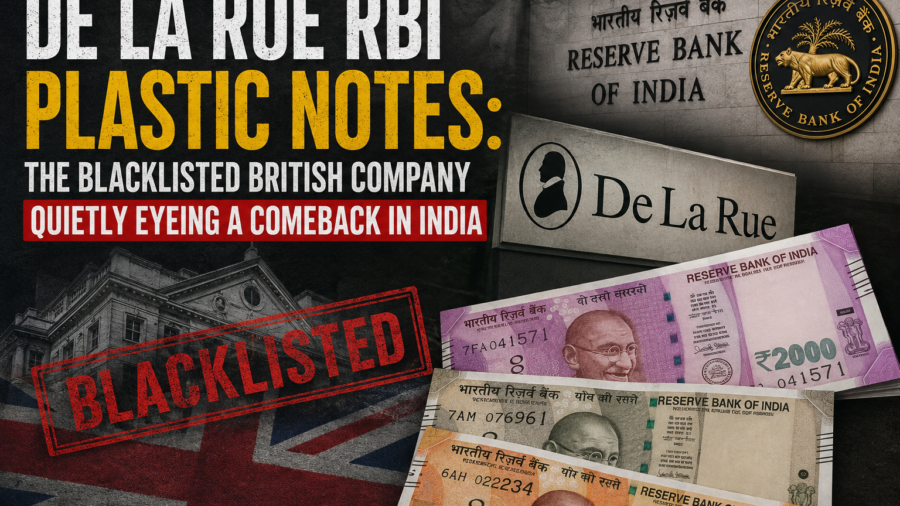
De La Rue RBI plastic notes talk has suddenly come back into the spotlight, and the story behind it is far more dramatic than a simple currency upgrade. A 200-year-old British firm that was once thrown out of India’s currency-printing business over a counterfeit scandal is now being mentioned again as the Reserve Bank of India quietly explores polymer, or plastic, banknotes. The twist? This isn’t the first time De La Rue has tried to work its way back into India’s currency system — and the company’s past here is packed with blacklisting, Panama Papers mentions, and unanswered questions that never really went away.
De La Rue India connection goes back further than most people realise. Founded in London way back in 1813, De La Rue started out printing playing cards and postage stamps before becoming one of the world’s biggest names in secure currency printing. In fact, De La Rue even printed India’s very first postage stamps during British rule. Over the decades, it grew into a global banknote powerhouse, supplying paper, security threads, holograms and anti-counterfeit features to more than 140 countries — India being one of its biggest and most valuable clients for years.
Why Was De La Rue Blacklisted by RBI?
RBI polymer notes discussions cannot be separated from De La Rue’s troubled past with the central bank. The trouble started around 2009-2010, when the CBI, while investigating a counterfeit currency racket along the India-Nepal border, traced some suspicious threads back to banknote paper quality issues. RBI sent a senior official to inspect De La Rue’s printing facility in Hampshire, UK, as part of the fact-finding exercise. Following this episode, RBI excluded the company from fresh contracts, and by February 2011, De La Rue was officially blacklisted.
The fallout was massive for the company. India, at the time, imported nearly 95% of its security paper requirements, and RBI’s business was believed to account for a significant chunk of De La Rue’s global profits. Losing that contract sent De La Rue’s shares tumbling, and the company nearly went bankrupt. Its then CEO exited under mysterious circumstances soon after the scandal broke.
De La Rue Controversy: Panama Papers and Political Allegations
The De La Rue controversy didn’t end with the blacklisting. The company’s name later surfaced in the Panama Papers leak, with allegations of involvement in a money-laundering scheme. Political parties in India, including AAP, alleged that De La Rue had paid a hefty commission to a Delhi-based businessman to help it secure RBI contracts — although these claims were never independently verified by major publications. During the 2016 demonetisation period, rumours also spread online claiming De La Rue was secretly supplying paper for the newly printed ₹500 and ₹2,000 notes. De La Rue publicly denied any such involvement, stating clearly that it was not associated with Indian currency printing at the time. Government records also confirmed that no new contracts were awarded to the company between 2014 and 2016.
Instead of bringing De La Rue back, India chose to build its own capacity. The Security Paper Mill in Mysuru, a domestic joint venture, was scaled up to produce most of the currency paper the country needed — reducing reliance on foreign suppliers.
De La Rue RBI Plastic Notes: The Polymer Currency Angle
So where does the De La Rue RBI plastic notes story pick up again? Back in 2012, RBI’s currency-printing arm, Bharatiya Reserve Bank Note Mudra Private Limited (BRBNMPL), shortlisted four global vendors for a polymer note pilot project — De La Rue (UK), Innovia (Australia, now part of CCL Secure), Giesecke & Devrient (Germany), and Landquart (Switzerland). That pilot never scaled up nationally, but the idea of moving to polymer or plastic notes has resurfaced strongly in 2026.
Reports suggest RBI polymer notes are now being seriously evaluated once again, with BRBNMPL issuing a tender for polymer substrate suppliers. Notably, the tender requires bidders to prove their polymer sheets are free from animal tallow or animal DNA content — a sensitive requirement given India’s religious and cultural sentiments around cow-derived products. Only a handful of global players, including De La Rue, CCL Secure and Louisenthal, control close to 90% of the world’s polymer banknote substrate market, which makes De La Rue’s re-entry into the conversation almost unavoidable, blacklist history notwithstanding.
De La Rue Today: A Very Different Company
Interestingly, the De La Rue that could bid for India’s polymer note project today is not the same company it was during the 2011 blacklisting. In 2025, De La Rue was taken over by US investor Atlas Holdings in an all-cash deal worth around £263 million, and the company was delisted from the London Stock Exchange. It had already sold off its Authentication division to Crane NXT, turning itself into a pure-play currency printing business. In early 2026, De La Rue also entered a joint venture with Canadian Bank Note Company to bid for the UK’s own passport-printing contract, signalling a broader restructuring and comeback push globally.
De La Rue RBI Plastic Notes: Quick Fact Table
| Aspect | Detail |
|---|---|
| Company founded | 1813, London (over 200 years old) |
| Blacklisted by RBI | February 2011, after counterfeit-related probe |
| Reason for blacklist | Quality-control and security concerns flagged during CBI investigation |
| Major controversy | Named in Panama Papers; commission-payment allegations |
| 2012 polymer shortlist | De La Rue, Innovia/CCL Secure, Giesecke & Devrient, Landquart |
| Current ownership | Acquired by Atlas Holdings (2025); delisted from London Stock Exchange |
| 2026 relevance | Possible bidder for RBI/BRBNMPL polymer note tender |
| RBI’s official stand | No confirmed plan to fully replace paper notes; polymer “under consideration” |
Has RBI Confirmed Plastic Notes for India?
It’s important to separate fact from viral rumour here. Several social media posts in mid-2026 claimed RBI would completely withdraw paper currency and replace it with plastic notes by June 30, 2026. The Press Information Bureau (PIB) officially fact-checked and rejected this claim, confirming that no such directive exists and that paper notes remain legal tender. RBI Governor Sanjay Malhotra, after the Monetary Policy Committee meeting in June 2026, did confirm that polymer notes are under consideration and that the central bank is examining the pros and cons — but a full nationwide rollout has not been announced.
Why This Story Matters
The De La Rue RBI plastic notes debate is really about two bigger questions for India: whether the country is ready to move toward more durable, counterfeit-resistant polymer currency, and whether a company with De La Rue’s controversial history should be allowed back into such a sensitive, security-linked contract. Supporters argue that De La Rue, CCL Secure and Louisenthal are simply the most experienced players in the world for this specific technology, and excluding them limits India’s options. Critics point to the unresolved questions from the 2011 blacklisting and the Panama Papers episode as reasons for caution.
Conclusion
Whether or not De La Rue eventually wins any part of India’s polymer note project, its name resurfacing alongside RBI’s plastic currency plans is a reminder of how tangled and long-running India’s relationship with foreign currency printers has been. As BRBNMPL moves forward with its polymer substrate tender and RBI continues evaluating the shift, the coming months should make it clearer whether this 200-year-old British company gets a genuine second chance in India — or stays on the sidelines of a business it once dominated.