ITC share price today is once again in the spotlight, and not for the reasons long-term investors were hoping for. One of India’s most-held blue-chip stocks — a Nifty 50 and Sensex heavyweight that millions of Indians own through direct holdings, mutual funds or insurance policies — has been steadily losing ground for months. So what’s really going on with a company that owns everything from cigarettes to biscuits, hotels to paperboards? Let’s break down the ITC share price today story in plain, simple terms.
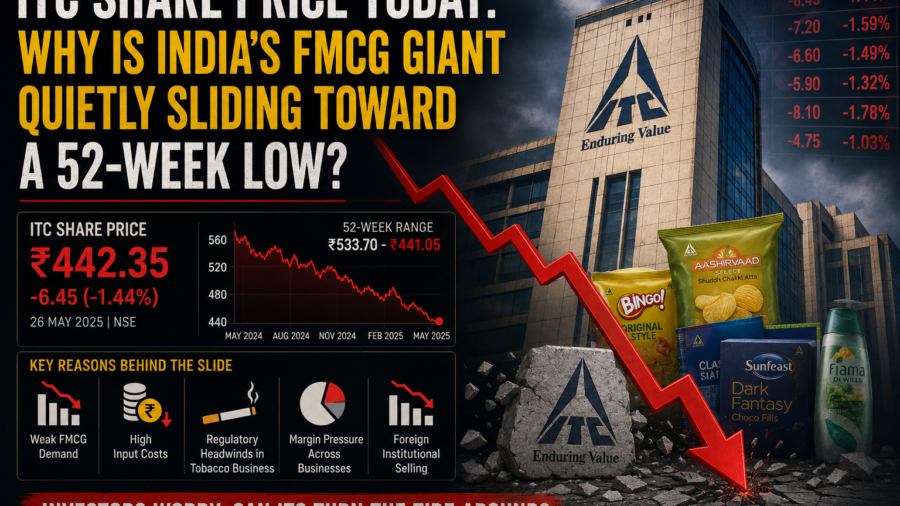
ITC stock price closed around ₹255.50 as of August 31, 2026, with the company’s market capitalisation standing at roughly ₹3.37 lakh crore. That’s a steep fall from its 52-week high of ₹427, meaning the stock has lost close to 40% of its value from the peak. Just a week earlier, on August 28, ITC was trading near ₹268, and before that, around ₹269 on August 24 — showing the stock has been grinding lower session after session rather than crashing in one dramatic move.
Why Is ITC Share Price Falling? The Real Reasons
ITC share price today reflects a mix of policy pressure and sectoral headwinds rather than any single dramatic event. Here’s what’s actually driving the fall:
- Cigarette taxation overhaul: The government notified a new tax structure for tobacco products, ending the old GST compensation cess and replacing it with a fresh excise duty structure effective February 1, 2026. This duty, ranging roughly between ₹2,050 and ₹8,500 per 1,000 sticks depending on cigarette length, sits on top of the already-high 40% GST slab on cigarettes.
- Cigarette business under pressure: Since cigarettes remain ITC’s single most profitable segment despite the company’s diversification, any tax hike here directly hits overall earnings and investor sentiment.
- West Asia conflict impact: Ongoing geopolitical tension in the Middle East has weighed on ITC’s agri-business exports, adding another drag on the company’s Q1 FY27 performance.
- FPI selling: Foreign portfolio investors trimmed their stake in ITC to around 11.3% by Q2 FY27, reflecting reduced confidence from overseas institutional money.
- Sector-wide underperformance: ITC has underperformed both the broader Sensex (down roughly 9%) and the FMCG index (down roughly 8%) over the same stretch, showing this isn’t purely a company-specific story but also a tough phase for consumer stocks in general.
ITC Share Price Today: Key Numbers at a Glance
| Parameter | Detail |
|---|---|
| ITC share price (Aug 31, 2026) | ₹255.50 |
| Market capitalisation | ~₹3,37,552 crore |
| 52-week high | ₹427 |
| 52-week low | ₹264.80 (recently touched ₹273.05 intraday) |
| Dividend yield | 5.38% |
| P/E ratio | 16.32 |
| P/B ratio | 4.63 |
| YTD decline | Around 25% |
| Analyst target price range | ₹300 – ₹350 (varies by brokerage) |
| FPI holding (Q2 FY27) | 11.3% |
(Prices and ratios are indicative of the trading session referenced and can change as markets move.)
ITC Q1 Results: What the Numbers Actually Showed
ITC Q1 results for FY27 came in weaker than expected, with record-high cigarette taxation weighing directly on the company’s core cash-generating business. Net sales excluding excise duty saw a year-on-year decline in the review quarter, though the FMCG-Others segment continued to grow at a healthy pace of over 15% YoY, showing that ITC’s non-cigarette businesses are still expanding even while the tobacco arm faces headwinds. The agri-business segment, however, posted a decline of over 14% YoY, largely attributed to the disruption caused by the West Asia conflict affecting export routes and demand.
ITC Dividend and Corporate Actions
Despite the price pressure, ITC dividend history remains one of the stock’s biggest draws for long-term and income-focused investors. The board recommended a final dividend of ₹8 per equity share for FY26, translating into a dividend yield north of 5% at current price levels — among the highest in the large-cap FMCG space. On the corporate action front, ITC allotted over 3.13 lakh shares under its Employee Stock Option Scheme on August 14, 2026, and it also completed the acquisition of Century Pulp and Paper from Aditya Birla Real Estate on August 1, 2026, strengthening its paperboards and packaging business.
ITC Share Price Target: What Are Analysts Saying?
Brokerages remain divided on where ITC stock price heads from here. Some analysts have set target prices in the ₹300–₹320 range, citing continued pressure from cigarette taxation and competition, while pointing to the FMCG and agri segments as potential long-term growth drivers. More bullish voices, including a recent Jefferies upgrade, have flagged a much higher target closer to ₹350, citing overall growth prospects across ITC’s diversified portfolio. The wide gap between these targets shows just how uncertain the near-term outlook is, even among professional analysts.
Should Investors Worry About ITC Stock?
For existing shareholders and those tracking Nifty ITC movements, the key question is whether this is a temporary tax-driven correction or the start of a deeper structural problem. On the positive side, ITC remains almost debt-free, maintains a strong return on equity of over 35% (3-year average), and has a consistent dividend payout ratio of nearly 75%. On the cautious side, cigarette taxation pressures aren’t going away anytime soon, and the stock’s heavy dependence on this single segment for profitability remains a genuine long-term concern that the market continues to price in.
What to Track Next
Going forward, here are the key triggers investors watching ITC share price today should keep an eye on:
- Any further changes in cigarette excise duty or GST rates from the government.
- Management commentary on how much of the tax burden is being passed on to consumers through price hikes.
- Progress and integration updates on the Century Pulp and Paper acquisition.
- FMCG-Others segment growth momentum in coming quarters.
- Broader FMCG sector trends and how they compare with ITC’s own performance.
Conclusion
The ITC share price today story is really a tale of a strong, cash-rich company navigating a tough policy environment for its core cigarette business, while its other segments — FMCG, agri, paperboards and hotels (post-demerger) — try to pick up the slack. Whether the stock finds a floor near its current 52-week low zone or slides further will largely depend on tax policy clarity and how quickly the non-cigarette businesses can scale up. As always, investors should track fundamentals and long-term diversification trends rather than reacting to short-term price swings.