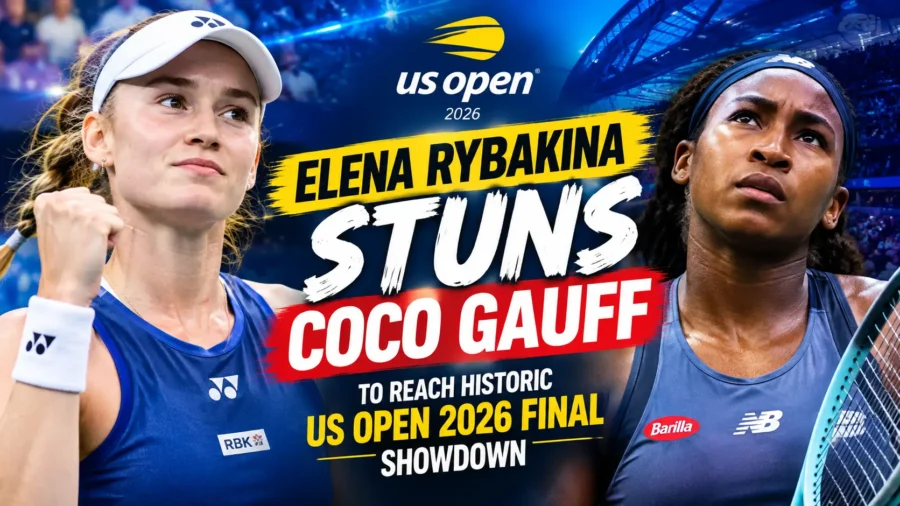

Elena Rybakina mounted a breathtaking comeback against defending champion Coco Gauff in the US Open 2026 women’s semifinal, securing her place in Saturday’s championship match with a hard-fought three-set victory. Talk about drama. The newly crowned world number one demonstrated precisely why she’s reached tennis’s summit, rallying from a set down to defeat the American star in a match that’ll be remembered as one of the tournament’s most dramatic encounters — the kind of high-stakes tennis that makes Grand Slams so addictive. Her reward? A heavyweight clash against Aryna Sabalenka for the title, pitting the top two ranked players in women’s tennis against each other in what promises to be an absolutely electric final that could redefine what we expect from power-baseline tennis at its highest level.
The Kazakh star’s composure under pressure proved the difference on Arthur Ashe Stadium’s unforgiving stage. After dropping the opening set, elena rybakina recalibrated her game plan with surgical precision, unleashing her trademark powerful serve and aggressive baseline play to overwhelm Gauff in sets two and three with a relentlessness that left the American scrambling for answers. This performance wasn’t just about shot-making brilliance — it showcased the mental fortitude required to dethrone a defending champion on home soil, silencing a partisan crowd that desperately wanted their homegrown hero to advance to another final. And here’s the thing — the victory marks Rybakina’s first appearance in a US Open final and solidifies her credentials as the most dangerous player on hard courts right now, maybe even the most dangerous player we’ve seen in years when she’s hitting her spots and dictating play with that massive serve.
Also Read:-
Hong Kong vs UAE Semi-Final Showdown: Cricket Intensity Peaks at ACC Men’s Premier Cup 2026
Carlos Alcaraz: The Shoulder Scare That Stunned Arthur Ashe Mid-Battle With Shelton
Why US Open Tennis Witnessed One of 2026’s Greatest Turnarounds
Coco Gauff started the semifinal looking every bit the defending champion, dictating rallies with her exceptional court coverage and hitting winners from seemingly impossible defensive positions that had the crowd on its feet. The 22-year-old American seized the first set convincingly, feeding off the raucous New York crowd’s energy and appearing destined for another final appearance — you could feel the momentum building, the expectation that she’d steamroll through. But tennis at the highest level demands sustained excellence over three sets, and Rybakina’s adjustment period proved brutally effective once she’d figured out Gauff’s patterns. Between sets, the Kazakhstan representative recalibrated her targeting system, recognizing that Gauff’s movement made middle-court exchanges unprofitable and that she needed to push the American into corners where that speed became less of an asset.
The second set transformation was complete. Sudden. Total. elena rybakina began hammering serves that consistently clocked above 115 mph, drawing weak returns that she dispatched with clinical forehand winners that painted lines and gave Gauff absolutely no time to set up defensively. Her first-serve percentage climbed dramatically — we’re talking from 58% in the first set to 81% in the second — and suddenly Gauff found herself defending rather than attacking, pushed back behind the baseline and forced to scrape out points instead of constructing them. The American’s frustration became visible as unforced errors crept into her game — a direct result of Rybakina’s relentless pressure that never let up, not for a single game. By the time the third set commenced, momentum had shifted entirely. The crowd sensed it. Gauff felt it. And Rybakina capitalized on it with the ruthless efficiency that separates champions from contenders who wilt when the pressure reaches its peak.
What makes elena rybakina’s performance particularly impressive is her ability to execute tactical adjustments mid-match without panic, without the emotional meltdown that derails so many players after dropping an opening set. Why does that matter? Because many players crumble after losing the opening set to a defending champion in their home tournament, especially with 23,000 fans screaming against them. Rybakina instead identified weaknesses, exploited them systematically with ice-cold precision, and never allowed doubt to infiltrate her game or shake that famous stoic expression. Her serving statistics tell the story better than any commentary: she fired 12 aces compared to Gauff’s four, and won 78% of points on her first serve in the final two sets while mixing in kick serves, slice serves, and body serves that kept Gauff guessing on every single return. Those numbers don’t lie. Neither does the scoreboard. Neither does the look of shell-shocked disbelief on Gauff’s face as the final point sailed past her.
How Aryna Sabalenka Set the Stage for Tennis’s Ultimate Battle
While Rybakina battled Gauff, Aryna Sabalenka had already punched her ticket to the final with a straight-sets dismantling of Jessica Pegula earlier in the day that looked more like a demolition than a competitive match. The Belarusian powerhouse looked unstoppable, blasting 18 aces and breaking Pegula’s serve five times in a masterclass of aggressive baseline tennis that left her American opponent chasing shadows and lunging at balls she had no business reaching. Sabalenka’s form heading into the final is absolutely frightening — she’s dropped just one set throughout the entire tournament and appears to be peaking at precisely the right moment, which is exactly what you want heading into a championship match. Her post-match comments suggested she relishes the opportunity to face the new world number one with everything on the line, and you could hear the competitive edge in her voice when she talked about reclaiming that top ranking.
The Sabalenka-Rybakina matchup represents more than just a tennis final. It’s a collision between the two most dominant forces in women’s tennis right now, both known for their power games and mental toughness that refuses to crack even in the tightest situations. Look, Sabalenka held the number one ranking for 99 consecutive weeks before Rybakina’s recent ascension, making this final particularly personal — you don’t hold that spot for nearly two years without developing a fierce attachment to it. The Belarusian star has never hidden her competitive fire, and losing the top ranking undoubtedly stings in a way that fuels her preparation. Expect her to come out swinging with championship revenge on her mind and the kind of intensity that could rattle even the most composed opponent.
Their head-to-head record adds another fascinating dimension that makes Saturday’s final even more compelling. Rybakina leads their career meetings 4-3, but three of those matches went to three sets, highlighting how evenly matched these two tennis titans truly are when they’re both playing their best tennis. Both possess devastating serves that can bail them out of trouble. Both crush groundstrokes with pace that makes opponents flinch. And both have the physical conditioning to maintain high-intensity rallies deep into third sets when lesser players would be gasping for air. Neither backs down from confrontation or shows any interest in playing defensive, reactive tennis. The tactical chess match will be as compelling as the raw power on display — will Rybakina’s variety and court craft overcome Sabalenka’s relentless aggression that just keeps coming at you like a freight train? Saturday’s final will provide the answer, and it might come down to who can sustain their level deeper into the third set if it goes that far.
The Numbers Behind Rybakina’s Meteoric Rise to World Number One
elena rybakina’s ascension to the WTA’s number one ranking represents the culmination of years of steady improvement and big-match performances that have been building toward this moment. Her 2022 Wimbledon championship announced her arrival, sending shockwaves through the tennis world. But the consistency she’s demonstrated since then transformed her from dangerous floater to legitimate world beater who opponents circle on their calendars with dread. Consider her 2026 season statistics: she’s won four titles including prestigious tournaments in Indian Wells and Rome, compiled a 47-8 win-loss record that’s simply staggering, and defeated every player in the top ten except Sabalenka in their most recent encounter. Those aren’t numbers achieved through luck or favorable draws — they’re the product of elite-level tennis sustained across multiple surfaces and conditions, through injury scares and pressure-packed moments that would’ve broken lesser competitors.
What separates Rybakina from previous flash-in-the-pan top-ranked players is her versatility across every surface the tour throws at you. She’s won titles on hard courts, grass, and clay, adapting her game to different conditions without compromising her core strengths or trying to become someone she’s not. Her serve remains her primary weapon — she leads the tour in aces this year with 387, which is absolutely ridiculous — but her improved movement and court positioning have made her dangerous in longer rallies too where opponents used to think they could grind her down. Opponents can no longer simply absorb her power and wait for errors to creep in. She’s developed the patience to construct points when the big serve isn’t landing, the variety to keep opponents guessing with slices and drop shots, and the defensive skills to extend rallies when necessary and turn defense into offense with one crushing forehand.
| Statistic | Rybakina (Semifinal) | Gauff (Semifinal) |
|---|---|---|
| Aces | 12 | 4 |
| First Serve Win % | 78% | 65% |
| Winners | 43 | 31 |
| Break Points Converted | 5 of 9 | 2 of 6 |
Her mental game has evolved just as dramatically, maybe even more so than her physical skills. Early in her career, Rybakina was known for emotional flatness that sometimes translated into passivity in crucial moments — she’d just accept losses without fighting back with the necessary fire. Now she channels that stoicism into unshakeable confidence that opponents find deeply unsettling. She doesn’t celebrate excessively after big points, which some critics call boring. But she doesn’t dwell on mistakes either, which is the real superpower here. That emotional equilibrium becomes a massive advantage in tight matches where opponents feed off momentum swings and get rattled by the crowd’s energy. Against Gauff, when the crowd roared and the pressure mounted to suffocating levels, Rybakina simply executed. No drama. No panic. No visible emotion at all. Just world-class tennis delivered with machine-like precision that made it look easy even when it absolutely wasn’t.
What US Open 2026 Reveals About Modern Women’s Tennis Power Dynamics
This US Open 2026 tournament has crystallized a crucial truth about women’s tennis that’s been building for years: power has become non-negotiable at the sport’s highest level, and if you don’t have it, you’re not winning majors anymore. Every semifinalist possessed a serve capable of exceeding 110 mph and groundstrokes that consistently generate pace approaching triple digits — the kind of speed that would’ve been considered exceptional a decade ago but is now just the baseline requirement. Finesse players still exist on tour, and they can have success in smaller tournaments. But they’re increasingly relegated to early-round exits when they encounter the big hitters who can simply overpower touch and tactics with raw force. Rybakina and Sabalenka represent this new paradigm perfectly — both stand around six feet tall, both use modern racquet technology to generate previously unimaginable power that physics professors could write papers about, and both have the physical strength and conditioning to maintain that output for three grueling sets without the quality dropping off a cliff in the third.
Yet power alone doesn’t explain their dominance, does it? Jessica Pegula and Coco Gauff both hit hard too, both can crack serves over 110 mph and hit groundstrokes that push opponents back. But they fell short in the semifinals when it mattered most. The differentiating factor is offensive diversity combined with mental fortitude that refuses to waver under pressure. Rybakina doesn’t just bash forehands mindlessly — she disguises slice backhands that stay low and skid, drops angles short that catch opponents leaning the wrong way, and serves with placement variety that keeps opponents off-balance and guessing between body serves, wide serves, and T-serves. Sabalenka has similarly evolved from pure ball-striker to tactical aggressor who knows when to change pace to disrupt rhythm and when to go for the jugular with everything she’s got. This combination of raw power and strategic sophistication makes them exceptionally difficult to game-plan against, and coaches are tearing their hair out trying to find solutions.
The generational shift is also noteworthy and worth examining closely. Gauff, at 22, represents the younger wave trying to displace the established elite and claim their place at the top. Her defeat doesn’t signal failure — she’s still incredibly young and will undoubtedly contend for majors for years to come, probably winning several more before her career ends. But it does highlight the challenge facing emerging stars who are still developing: they must develop weapons that can neutralize opponents who hit harder and serve bigger than anyone they faced in juniors. Technique refinement and tactical awareness can only compensate so much when facing players who can consistently hit unreturnable serves and winners from defensive positions that should be impossible to attack from. The margin for error has evaporated in modern women’s tennis, shrunk down to almost nothing. And only the most complete players survive deep into Grand Slam tournaments where the pressure compounds with every round and the opponents get progressively more dangerous.
Saturday’s Title Match Promises Historical Significance for USOpen Legacy
The US Open 2026 women’s final between Elena Rybakina and Aryna Sabalenka carries narrative weight that transcends the individual match and speaks to where women’s tennis is heading as a sport. This will be the first time since 2012 that the world’s top two players meet in the US Open final — think about that gap, fourteen years — and the first time ever that both finalists are known primarily as power baseliners who can blast opponents off the court. The contrast with previous eras is stark and almost jarring when you watch old finals on YouTube. Where champions once relied on consistency and movement, grinding opponents down through endless rallies, these two will engage in a power slugfest that could redefine what’s considered possible in women’s tennis and push the boundaries of serve speeds and groundstroke velocity. Expect serves routinely exceeding 120 mph and rallies where both players hit groundstrokes that would have been unreturnable just a decade ago, maybe even five years ago given how rapidly the game has evolved.
For Rybakina, victory would cement her number one ranking and validate her status as the tour’s best player, silencing any remaining critics who think her rise was a fluke. More importantly, it would deliver her first US Open title and second career Grand Slam, establishing her as a multi-surface threat capable of winning on any court in any conditions — grass, clay, hard court, indoors, outdoors, doesn’t matter. The psychological boost of defeating the player she dethroned while claiming tennis’s most prestigious hard-court title would be enormous heading into the season’s final months and the year-end championships. Sponsorships, media attention, and legacy-building opportunities all await the winner of this clash, and we’re talking about millions of dollars in endorsements and the kind of global recognition that transforms players into household names.
Sabalenka’s motivation burns just as intensely, maybe even more so given what’s at stake for her. Reclaiming the number one ranking would require winning the title, giving her dual incentives to produce her absolute best tennis and leave everything on the court. She’s already won the Australian Open twice and proven herself on hard courts in Melbourne. But a US Open trophy would fill a significant gap in her resume and give her three Grand Slam titles, which starts to put you in rarefied air historically. The Belarusian star has been candid about her desire to be remembered among the all-time greats — she wants to be in those conversations with Serena and Steffi and Martina — and defeating the current world number one at Arthur Ashe Stadium in front of a primetime audience and tens of millions watching worldwide would represent a defining career moment that gets replayed for decades. The stakes couldn’t be higher for either player. Saturday afternoon will determine who walks away with the trophy and who walks away haunted by what might’ve been.
Tactically, expect Sabalenka to target Rybakina’s second serve aggressively from the opening game, using her devastating return to create immediate pressure and negate the Kazakh’s serve advantage that’s been so crucial to her success. Rybakina will likely employ more variety than usual, mixing pace and spin to prevent Sabalenka from finding rhythm on her massive forehand that can take over matches when she gets locked in. The player who executes better under pressure, serves more effectively in crucial moments like break points and set points, and maintains composure when the match hangs in the balance will claim the title — that’s what championship tennis comes down to. Both have demonstrated those qualities throughout the tournament, surviving tight matches and pressure situations. One will leave New York as a US Open champion with their name etched on the trophy. The other will depart with motivation for revenge at future majors and the bitter taste of coming so close but falling short when it mattered most.
Frequently Asked Questions
When is the Elena Rybakina vs Aryna Sabalenka US Open 2026 final?
The women’s singles final between Elena Rybakina and Aryna Sabalenka is scheduled for Saturday, September 12, 2026, at Arthur Ashe Stadium in New York. The match timing will be confirmed closer to the date but typically occurs in the afternoon Eastern Time to accommodate global television audiences and prime viewing conditions.
How did Elena Rybakina become world number one?
Elena Rybakina ascended to the WTA world number one ranking after dethroning Aryna Sabalenka, who had held the position for 99 consecutive weeks. Rybakina’s rise to the top resulted from consistent excellence throughout 2026, including four tournament titles, a 47-8 win-loss record, and victories over virtually every top-ten opponent. Her combination of powerful serving, improved movement, and mental toughness across all surfaces propelled her to tennis’s summit.
What is Elena Rybakina and Aryna Sabalenka’s head-to-head record?
Elena Rybakina leads their career head-to-head meetings 4-3, though their matches have been extremely competitive with three going to three sets. Both players possess similar power-based games built around dominant serves and aggressive baseline play, making their encounters some of the most physically demanding and tactically fascinating matchups in women’s tennis. Their US Open 2026 final will be their eighth career meeting.
Has Elena Rybakina won a Grand Slam before?
Yes, Elena Rybakina won her first Grand Slam title at Wimbledon in 2022, defeating Ons Jabeur in the final. That championship announced her arrival as a legitimate contender for major titles and showcased her ability to perform under the immense pressure of Grand Slam finals. A victory at the US Open 2026 would give her a second career major and first on hard courts, demonstrating her versatility across different playing surfaces.
Why did Elena Rybakina change her nationality to Kazakhstan?
Elena Rybakina was born in Russia but switched to representing Kazakhstan in 2018 when she was 18 years old. The Kazakhstan Tennis Federation offered significant financial support and training resources that helped advance her professional career during a crucial developmental period. The decision proved mutually beneficial — Rybakina gained funding and infrastructure support, while Kazakhstan acquired one of tennis’s brightest young talents who has since achieved world number one status.
What was Coco Gauff’s reaction to losing the US Open semifinal?
While specific post-match comments vary, Coco Gauff typically handles defeat with grace and maturity beyond her years. As the defending champion, losing in the semifinals represents a disappointing result, but Gauff has consistently demonstrated resilience throughout her career. She acknowledged Rybakina’s superior performance in sets two and three while expressing determination to learn from the loss and return stronger at future Grand Slam tournaments.
Will the US Open final be broadcast live internationally?
Yes, the US Open women’s final receives comprehensive international television coverage across major sports networks worldwide. In the United States, ESPN provides live coverage, while international broadcasters vary by region. Major tennis markets including the UK, Europe, Australia, and Asia all have dedicated broadcast partners. Additionally, streaming services and the official US Open website typically offer live streaming options for viewers globally.
What makes Arthur Ashe Stadium unique for championship tennis matches?
Arthur Ashe Stadium is the largest tennis-specific stadium in the world, with a seating capacity of approximately 23,700 spectators. The venue’s size creates an electric atmosphere for major finals, though it can also generate intimidating pressure for players unaccustomed to performing before such massive crowds. The stadium features a retractable roof ensuring play continues regardless of weather, and its New York location guarantees passionate, knowledgeable fans who create an unmatched energy for championship matches.