
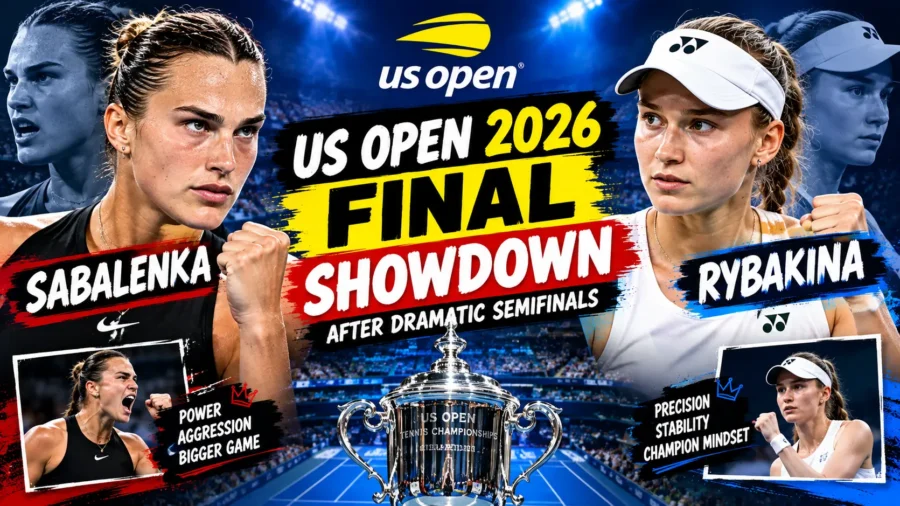

US Open Tennis reaches its crescendo as Aryna Sabalenka and Elena Rybakina prepare for a blockbuster women’s singles final at Flushing Meadows. The championship match scheduled for September 13, 2026, promises fireworks after both players delivered commanding semifinal victories. Absolutely commanding. Sabalenka dismantled Jessica Pegula’s home crowd hopes while Rybakina silenced Arthur Ashe Stadium by defeating defending champion Coco Gauff in straight sets — and she made it look almost effortless in doing so.
The path to this final has been nothing short of spectacular, hasn’t it? Sabalenka, the 2024 US Open champion, showcased why she’s considered one of the most dominant forces in women’s tennis — her power-baseline game absolutely overwhelmed Pegula 7-5, 7-5 in a match where momentum shifted constantly, swinging back and forth like a pendulum that refused to settle. Rybakina, meanwhile, produced clinical tennis against Gauff. Ice-cold. She won 6-3, 6-4 to reach her second Grand Slam final, demonstrating the kind of composure that separates contenders from genuine champions who rise to the occasion when the lights burn brightest. Both women arrive at this championship encounter battle-tested, hungry, and playing their absolute best tennis when it matters most — precisely when the stakes couldn’t possibly be higher and the pressure threatens to crush lesser competitors.
Also Read:-
Elena Rybakina Beats Coco Gauff to Reach US Open 2026 Final
Hong Kong vs UAE Semi-Final Showdown: Cricket Intensity Peaks at ACC Men’s Premier Cup 2026
This final represents more than just another Grand Slam title opportunity. For Sabalenka, it’s a chance to cement her legacy with a third major championship and prove her consistency at the highest level — to show the world that her previous victories weren’t flukes but rather the beginning of a dynasty in the making. For Rybakina, victory would mark her second Grand Slam title and validate her potential as tennis’s next dominant figure, the player who could control the sport for years to come if she continues developing at this trajectory. The contrast in styles — Sabalenka’s aggressive baseline bombardment versus Rybakina’s ice-cold precision and massive serve that regularly hits triple digits on the speed gun — sets up tactical chess that will captivate tennis purists worldwide and casual fans alike who simply want to witness excellence.
Rybakina Dominance: How Elena Silenced the New York Crowd
Elena Rybakina entered Arthur Ashe Stadium knowing she faced not just Coco Gauff but 23,000 passionate American fans desperate to see their hometown hero prevail. The atmosphere was deafening. The Kazakhstani star, unfazed by the wall of noise that would’ve rattled most players, delivered a masterclass in composure under pressure that’ll be studied by coaches for years. Her 6-3, 6-4 victory wasn’t just about winning points — it was about suffocating an opponent through relentless depth, impeccable timing, and serves that clocked over 120 mph and landed with the precision of a guided missile finding its target every single time she needed it most.
Rybakina’s semifinal performance showcased exactly what makes her so dangerous on the biggest stages in this sport. She won 82% of first-serve points and converted 5 of 9 break point opportunities — efficiency that borders on robotic, yet somehow remains beautifully human in its execution. Gauff, who had staged a remarkable comeback victory in her quarterfinal match (saving two match points against Qinwen Zheng), simply couldn’t find rhythm against Rybakina’s controlled aggression that never gave her an opening to breathe or establish any kind of pattern. Every time Gauff tried to inject pace, Rybakina absorbed it and redirected with precision — like a martial artist using an opponent’s energy against them. The 2022 Wimbledon champion’s forehand was particularly lethal, consistently finding corners and pushing Gauff meters behind the baseline where recovery becomes nearly impossible and defensive scrambling becomes the only option available.
What stood out most was Rybakina’s mental fortitude in an environment designed to break her concentration. Playing a Grand Slam semifinal against a defending champion in hostile territory would crack many players. Not Elena. She held serve throughout the match, never faced a break point in the second set (think about that for a moment), and maintained her service game structure with robotic efficiency that suggested she was playing a practice session rather than a semifinal at the US Open tennis tournament. Her ability to raise her level in crucial moments — saving two break points in the opening set, then breaking Gauff’s serve at 4-4 in the second when the pressure was at its absolute peak — demonstrates championship pedigree that cannot be taught in any academy or training program, the kind of instinct that separates good players from all-time greats.
Sabalenka’s Semifinal Battle: The Numbers That Tell the Real Story
Aryna Sabalenka’s semifinal victory over Jessica Pegula looked routine on the scoreboard but required every ounce of her competitive fire. Every. Single. Ounce. The 7-5, 7-5 scoreline masks how competitive this match truly was — it was a knife-edge battle where either player could’ve seized control if the other had blinked even once. Pegula, playing in her first US Open semifinal with the weight of an entire nation’s expectations on her shoulders, pushed Sabalenka to the brink multiple times, testing not just her physical skills but her mental resolve in ways that only these high-pressure moments can. The Belarusian’s ability to find another gear when serving to stay in sets — she saved four set points across both sets, four moments where her tournament could’ve unraveled completely — separates elite champions from mere contenders who fold when the finish line comes into view.
Sabalenka fired 14 aces and won 70% of points on her first serve, statistics that underscore her serve’s devastating effectiveness when she’s locked in and trusting her mechanics. But this wasn’t just a power showcase, not by any stretch. Sabalenka demonstrated tactical maturity that she’s developed over the past two years, mixing speeds, adding slice to disrupt timing, and using drop shots to pull Pegula forward and disrupt her rhythm when she was settling into comfortable baseline exchanges. When Pegula threatened to level the first set at 5-5 and potentially grab the momentum that could’ve changed everything, Sabalenka unleashed three consecutive service winners — boom, boom, boom — that snuffed out the danger immediately. In the second set, trailing 3-5 and facing elimination with her tournament hanging by a thread, she broke Pegula’s serve twice in succession to claim victory in a display of champion’s mentality that left commentators searching for superlatives.
The mental transformation Sabalenka has undergone is remarkable — it might be the most impressive evolution in recent tennis history. Two years ago, she struggled with serving yips at this very tournament, committing double fault after double fault in situations that should’ve been routine. Now? She’s closing out tight sets with clutch serving that would make any great proud, finding spots under pressure that most players can only dream about in their best moments. Her 37 winners against just 24 unforced errors demonstrate controlled aggression — hitting through the court while managing risk in ways that suggest she’s finally found the balance between power and precision that eluded her earlier in her career. Pegula, despite the loss that ended her breakthrough run, pushed Sabalenka harder than the score suggests, forcing the favorite to elevate repeatedly and solve tactical puzzles on the fly. That pressure will serve Sabalenka well heading into the final — she’s already been tested by fire and emerged stronger for it.
US Open Championship Match Preview: Tactical Breakdown and Predictions
The women’s final on September 13 at Arthur Ashe Stadium pits two contrasting yet equally effective playing styles in what promises to be a tactical masterclass. Sabalenka’s game revolves around overwhelming opponents through sheer power and relentless aggression — she attacks every ball like it owes her money, takes the ball early to rob opponents of time, and dictates from the baseline with frightening consistency that makes you wonder how anyone ever beats her when she’s in this kind of form. Rybakina, conversely, plays a more patient power game — she’s equally capable of ending points with one shot (make no mistake about that) but chooses her moments with surgical precision, waiting for the perfect opening rather than forcing the issue and creating unnecessary risk.
The serve will be critical in determining who lifts the trophy. Both women possess weapons capable of producing free points at will, but Rybakina holds a slight edge when you examine the numbers closely. Her first serve is more consistent percentage-wise, and her variety keeps opponents guessing whether she’s going wide, down the T, or into the body where returning becomes a defensive scramble. Sabalenka’s serve generates more raw power — when she catches one clean, it’s virtually unreturnable — but it can become erratic under extreme pressure, particularly on second serves where she sometimes reverts to old habits. Return games will likely determine this match more than service games. Why? Because Sabalenka stands inside the baseline and attacks second serves viciously, taking them on the rise and immediately putting returners on the defensive. Rybakina prefers to neutralize first with deep returns that push servers back, then attack second or third ball when she’s dictating the geometry of the point.
Court positioning tells another fascinating story in this matchup. Sabalenka plays closer to the baseline than almost anyone on tour, absorbing pace and redirecting with interest — she feeds off speed and turns defense into offense faster than you can blink. This aggressive positioning allows her to control rallies and maintain offensive pressure, but it leaves her vulnerable to precision passing shots — exactly what Rybakina excels at producing when given even the slightest angle to work with. Expect Rybakina to use angles and depth variations to move Sabalenka laterally across the court, stretching her wide, then attack open courts with forehands that land like bombs in the vacant spaces. The Kazakhstani’s backhand slice, often overlooked in analyses of her game, could prove invaluable in breaking up Sabalenka’s rhythm and forcing her to generate pace rather than redirect it — a subtle tactical weapon that changes the entire complexion of rallies and makes Sabalenka work harder for every point she earns.
| Match Detail | Information |
|---|---|
| Match Date | Saturday, September 13, 2026 |
| Venue | Arthur Ashe Stadium, Flushing Meadows, New York |
| Court Surface | Hard Court (DecoTurf) |
| Prize Money (Winner) | $3.6 Million USD |
| Prize Money (Runner-Up) | $1.8 Million USD |
| Head-to-Head Record | Rybakina leads 4-3 |
| Last Meeting | Brisbane 2026 (Rybakina won 7-6, 6-3) |
| Sabalenka Grand Slam Titles | 2 (Australian Open 2023, US Open 2024) |
| Rybakina Grand Slam Titles | 1 (Wimbledon 2022) |
What This Final Means Beyond the Trophy
This championship match carries massive implications for women’s tennis hierarchy and who’ll be remembered as the era’s defining player. Sabalenka, currently ranked No. 2, would solidify her position as the dominant force in women’s tennis with a third major title — three Grand Slams before turning 29 puts her in rarefied air. She’s already won two Australian Opens and one US Open, collecting hardware at an accelerating pace. Another championship here puts her firmly in the conversation for best player of this generation and potentially No. 1 ranking depending on other results from tournaments happening simultaneously around the globe, with points dropping off for several top players who are defending titles elsewhere.
Rybakina’s trajectory is equally fascinating when you consider where she’s come from. She burst onto the scene with her 2022 Wimbledon triumph — remember how nobody saw that coming? — but has since battled injuries and consistency issues that threatened to derail what should’ve been a meteoric rise to the top of the sport. A US Open tennis championship would announce her arrival as a consistent major threat rather than a one-hit wonder, silencing critics who’ve questioned whether she has the drive to dominate year after year. At just 25 years old, Rybakina possesses the game to dominate for years if she stays healthy and maintains the focus that’s brought her to this moment. Her power, variety, and mental toughness make her a nightmare matchup for anyone — ask Gauff, who couldn’t solve the puzzle despite playing in front of her home crowd with everything riding on the line. Victory here transforms her from potential star to established champion, from someone with talent to someone with titles that prove it.
The financial stakes are substantial too, even for athletes who’ve already earned millions. The US Open tennis champion receives $3.6 million, while the runner-up takes home $1.8 million — that’s a $1.8 million difference for winning three sets of tennis, which provides all the motivation anyone should need. Beyond prize money that gets wired to bank accounts within days, Grand Slam titles unlock lucrative sponsorship deals, increased appearance fees, and enhanced marketability that can dwarf tournament earnings over the course of a career. Both women are already well-compensated (Sabalenka earned over $15 million in career prize money, Rybakina not far behind), but a US Open trophy exponentially increases their earning potential and global profile in markets where tennis viewership translates to endorsement opportunities. For context, Grand Slam champions can command appearance fees exceeding $500,000 for exhibition events — wealthy organizers will pay that much just to get a recent major winner to show up and play a few sets, no title on the line.
The Tournament Journey: How They Reached This Moment
Sabalenka’s path to the final wasn’t without challenges that tested her in different ways. She dropped sets to lower-ranked opponents early — frustrating moments where her focus wavered — but found her groove as the tournament progressed and the competition intensified. Her quarterfinal demolition of Madison Keys showcased her ability to raise her level against quality opposition who refused to be intimidated, with Keys pushing her hard before ultimately succumbing to the relentless pressure. The semifinal grind against Pegula tested her mental resilience in ways the earlier rounds couldn’t — exactly the kind of test champions need before finals to ensure they’re battle-hardened and ready for anything their opponent throws at them. Sabalenka has looked increasingly comfortable in New York, a stark contrast to her struggles here in previous years when the US Open tennis courts seemed to bring out the worst in her game and the yips that plagued her serving motion.
Rybakina navigated a brutal draw with clinical efficiency that made difficult wins look routine. She dispatched dangerous opponents like Ons Jabeur in the quarterfinals — a player who’s reached multiple Grand Slam finals herself — and Gauff in the semifinals without dropping a set in either match, maintaining such control that spectators almost forgot how good her opponents actually are. Her ability to maintain intensity across two-week slogs separates elite players from good ones who fade in week two when legs get heavy and minds get tired from the accumulated stress of high-stakes matches. Rybakina hasn’t faced a deciding set since the fourth round, suggesting she’s peaking at the perfect moment — right when it matters most. Her service games have been virtually unbreakable throughout this fortnight, and her return games have generated consistent pressure that forces opponents into uncomfortable positions where mistakes become inevitable.
The semifinal victories reveal much about both players’ championship credentials and psychological makeup under extreme duress. Sabalenka’s come-from-behind wins demonstrate her fighting spirit and ability to problem-solve mid-match when plan A isn’t working and adjustments need to happen on the fly — she’s not just a ball-basher anymore but a tactician who reads situations and adapts. Rybakina’s methodical dismantling of opponents shows her tactical intelligence and emotional control that never wavers regardless of score or circumstance — she could be up 5-0 or down 0-5 and you’d see the same expression on her face, the same body language that suggests nothing fazes her. One player thrives on adrenaline and crowd energy, feeding off the electricity in the stadium. The other excels in creating her own zone of focus regardless of external noise, blocking out everything except the ball and the court. Both approaches work at the highest level — there’s no “right” way to handle pressure. Saturday’s final determines which proves more effective on this particular day when both bring their A-games to Arthur Ashe Stadium for the us open tennis title.
Key Statistical Comparison Heading Into the Final
| Statistic | Aryna Sabalenka | Elena Rybakina |
|---|---|---|
| Aces Per Match (Tournament) | 9.2 | 11.5 |
| First Serve Percentage | 65% | 68% |
| First Serve Points Won | 72% | 76% |
| Break Points Converted | 48% | 52% |
| Winners Per Match | 34 | 28 |
| Unforced Errors Per Match | 26 | 19 |
| Average Match Duration | 1 hour 42 minutes | 1 hour 35 minutes |
The statistical comparison reveals fascinating contrasts in how these two champions approach the game at the highest level. Rybakina serves more aces and maintains higher first-serve percentages, suggesting her service games will be harder to break — she’s giving Sabalenka fewer looks at second serves, which is absolutely critical against someone who feasts on them. Sabalenka generates more winners per match but also commits more unforced errors — the aggressive high-risk, high-reward approach that defines her game and makes her so exciting to watch but also occasionally frustrating when the errors pile up at inopportune moments. Rybakina’s efficiency shows clearly in her match durations. Shorter matches. She wins faster by maintaining pressure without taking unnecessary risks that extend rallies beyond what’s required to win points, conserving energy that compounds over two weeks of competition. Sabalenka’s longer matches reflect her willingness to grind and battle through adversity, to hang in there when things aren’t clicking and wait for her moment to seize control — a different philosophy but equally effective when she’s locked in mentally.
Frequently Asked Questions
What are the dates for the US Open tennis tournament in 2026?
The US Open 2026 runs from August 24 through September 13, 2026, at the USTA Billie Jean King National Tennis Center in Flushing Meadows, New York. The tournament spans two weeks with qualifying rounds beginning a week earlier. The women’s singles final is scheduled for September 13, 2026, featuring Aryna Sabalenka and Elena Rybakina.
How much money does the winner of the US Open get?
The US Open women’s singles champion receives $3.6 million in prize money, while the runner-up earns $1.8 million. Total prize money for the 2026 US Open exceeds $75 million across all events, making it one of the richest tournaments in professional tennis. Semifinalists earn $950,000 each, and even first-round losers receive $100,000, reflecting the tournament’s commitment to player compensation.
Why is Elena Rybakina such a difficult opponent for top players?
Rybakina’s game combines power with precision in ways few players can match. Her first serve regularly exceeds 120 mph, making her service games nearly unbreakable when she’s dialed in. She possesses exceptional baseline depth that pins opponents behind the baseline, then attacks with pinpoint groundstrokes. Her mental composure under pressure is extraordinary—she rarely shows emotion and maintains focus regardless of score or situation. This combination makes her incredibly tough to break down over best-of-three-set matches.
Has Aryna Sabalenka overcome her serving problems?
Yes, dramatically. Sabalenka struggled with serving yips at the 2022 US Open, committing numerous double faults that derailed her campaign. She worked extensively with sports psychologists and technical coaches to rebuild her service motion and mental approach. By 2024, she won the US Open with confident serving that featured consistent placement and variety. Her 2026 tournament has seen her serve as a weapon rather than a liability, firing aces in crucial moments and maintaining composure when serving under pressure.
What is the head-to-head record between Sabalenka and Rybakina?
Elena Rybakina leads the head-to-head series 4-3 against Aryna Sabalenka. Their most recent meeting came in Brisbane 2026, where Rybakina won 7-6, 6-3. However, Sabalenka won their previous encounter at the 2025 Australian Open in three tight sets. Their matches consistently produce high-quality tennis with multiple three-set marathons in their history. The rivalry has intensified as both established themselves among the elite in women’s tennis.
Who are the favorites according to betting odds?
As of match day, most sportsbooks have this final listed as virtually even, with slight edges varying between bookmakers. Sabalenka’s experience in Grand Slam finals (she’s won two of three) gives her a narrow edge with some oddsmakers. Rybakina’s current form and head-to-head advantage make her equally appealing. The lack of a clear favorite reflects how evenly matched these players are and how their contrasting styles create tactical uncertainty.
What happens if the match is suspended due to weather?
Arthur Ashe Stadium features a retractable roof, so weather delays are unlikely to impact play. If unusual circumstances force suspension, the match would resume from the exact score and situation where it stopped. The tournament has contingency plans for all scenarios, though the roof system has virtually eliminated weather-related disruptions for championship matches. Play can continue regardless of external conditions, ensuring fans and players get a complete match.
Where can fans watch the US Open final?
In the United States, ESPN holds exclusive broadcast rights and will air the women’s final live on ESPN with streaming available on ESPN+. International broadcasters vary by region, with coverage available in over 200 countries. The match will also be available through the US Open’s official website and app for authenticated cable subscribers. Start time is expected around 4:00 PM Eastern Time, though exact scheduling depends on prior matches.




1 Comment