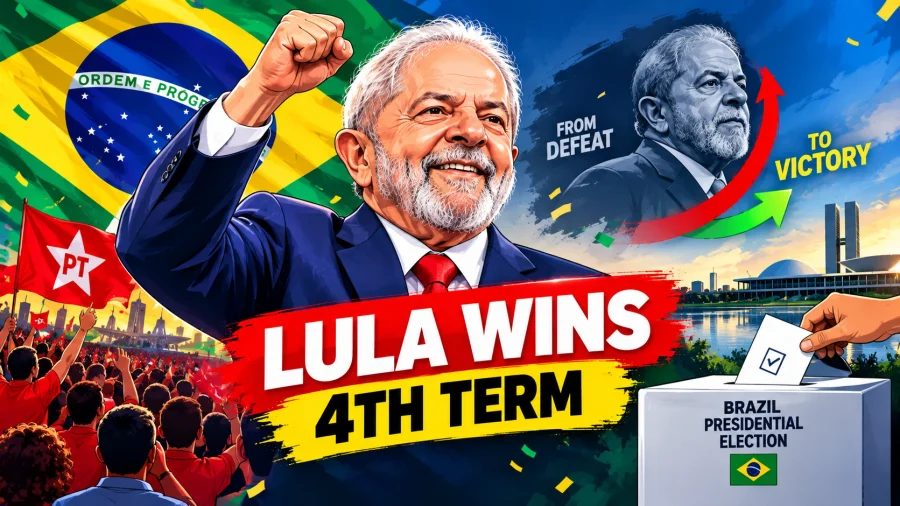

Brazilian presidential election night ended the way almost no poll said it would. Luiz Inácio Lula da Silva, who had trailed in the first round and was behind in the final surveys, won Sunday’s runoff to secure a fourth, non-consecutive term as president of Latin America’s largest economy. He beat Senator Flávio Bolsonaro by about 51.8% to 48.2%, a margin of nearly 4.4 million votes, in a contest that split the country almost down the middle.
Lula da Silva is 80 and turns 81 this week, and he framed this campaign as his final battle. The result is a major moment for Brazilian politics, for the Bolsonaro family’s political movement and for the countries that watch Brazil closely. This explainer sets out what happened, how it compares with the first round, what the Bolsonaro camp is saying, and the economic and political tests waiting for Lula Brazil’s new term, all in tables and plain language.
Brazilian Presidential Election 2026: The Result at a Glance
Brazilian presidential election results were declared by Brazil’s Superior Electoral Court (TSE) once 100% of the vote was counted. Lula took 51.8% of the valid vote to Flávio Bolsonaro’s 48.2%, and he led by almost 4.4 million votes. The court’s count showed the result was mathematically decided late on Sunday evening, local time.
Runoff Result, October 25, 2026
| Candidate | Party / Role | Share of Valid Votes |
|---|---|---|
| Luiz Inácio Lula da Silva | Workers’ Party (PT), incumbent president | About 51.8% |
| Flávio Bolsonaro | Liberal Party (PL), senator | About 48.2% |
| Margin | Lula ahead | Nearly 4.4 million votes |
Figures are rounded and vary by a hundredth of a point between outlets depending on when they were captured.
How the Brazilian Presidential Election Unfolded: First Round to Runoff
Brazilian presidential election rules require a candidate to win more than half of the valid votes to avoid a runoff, and in this case nobody did. In the first round on October 4, Flávio Bolsonaro finished ahead with 47.08% against Lula’s 45.11%, a lead of about 2.2 million votes. That put Lula on the back foot for the runoff three weeks later.
The runoff reversed that picture. A final Datafolha poll before the vote had put Flávio at 51% and Lula at 49%, within the margin of error, and many commentators called the race a technical tie. During the count, the gap between the two stayed under a point for a stretch, then widened in Lula’s favour. It is the first time since the end of military rule in 1985 that the runner-up in the first round went on to win the presidency.
First Round vs Runoff
| Stage | Date | Lula | Flávio Bolsonaro |
|---|---|---|---|
| First round | October 4, 2026 | 45.11% | 47.08% |
| Final Datafolha poll (runoff) | October 24, 2026 | 49% | 51% |
| Runoff result | October 25, 2026 | About 51.8% | About 48.2% |
What Happened on Runoff Day
Brazil runoff day was messy at polling places. A last-minute decision extended voting by two hours, and reports described chaos at some voting stations before the final tally. Despite that, the electoral court completed the count overnight, and Lula celebrated with supporters in São Paulo, where he watched the results with his wife, Rosângela da Silva, and allies.
Key Moments
| Moment | What Happened |
|---|---|
| Voting extended | Polling hours were extended by two hours |
| Early count | Lula and Bolsonaro were within about a point for part of the count |
| Count completed | Electoral court announced Lula’s lead as unassailable |
| Lula’s speech | Celebration with supporters in São Paulo |
| Bolsonaro response | Refused to concede and said he would seek annulment, per Reuters |
Lula da Silva: Who Is Brazil’s President-Elect?
Lula da Silva is a former trade union leader who first became president in 2003 and served two terms until 2010. He was convicted of corruption and spent 580 days in prison in 2018 and 2019, but his convictions were later annulled, allowing him to run again. In 2022 he narrowly beat Jair Bolsonaro in a runoff by about 50.9% to 49.1%, winning a third term.
His third term, from 2023, included a sweeping overhaul of consumption taxes and a new fiscal framework, while also facing the January 8, 2023, attacks on government buildings in Brasília. This fourth, non-consecutive term makes him the first person in Brazil’s democratic history to win a presidency four times.
Lula’s Path to a Fourth Term
| Year | Event |
|---|---|
| 2003 to 2010 | Serves two terms as president |
| 2018 to 2019 | Spends 580 days in prison; convictions later annulled |
| 2022 | Beats Jair Bolsonaro 50.9% to 49.1% |
| 2023 to 2026 | Third term as president |
| 2026 | Wins runoff against Flávio Bolsonaro for a fourth term |
Lula Brazil: When the New Term Begins
Lula Brazil will start its new government in January. Reports say the inauguration is scheduled for January 5, 2027, a date moved from the traditional January 1 under a constitutional change. His term runs through 2030. Before that, the electoral court typically formally certifies the winner, and the president-elect will begin naming a team and setting priorities.
For readers in India, one international point stands out: Brazil is a founding member of the BRICS group, which also includes India, China, Russia and South Africa, and Lula has argued for friendly relations with all major powers. Reports on the election result also noted that his win keeps some distance between Brazil and Washington, given his open criticism of President Trump.
Bolsonaro: What the Losing Side Is Saying
Bolsonaro is now a name that can mean two people, so it helps to separate them. Flávio Bolsonaro, 44, is a senator and the eldest son of former president Jair Bolsonaro, and he was Lula’s opponent in this runoff. Jair Bolsonaro, who lost to Lula in 2022, never accepted that result and was later given a 27-year sentence for plotting a coup to stay in power.
Reuters reported that Flávio Bolsonaro refused to concede defeat and said he would seek to annul the outcome, an echo of his father’s reaction four years ago. Brazil’s electoral court had declared Lula the winner after counting all of the votes, and any challenge would have to go through the courts. Readers should treat the claim as the losing campaign’s position and follow court filings for what happens next.
The Two Bolsonaros
| Name | Role | Relevance to This Election |
|---|---|---|
| Flávio Bolsonaro | Senator, Liberal Party | Lula’s opponent in the runoff; refused to concede |
| Jair Bolsonaro | Former president (2019 to 2022) | Lost to Lula in 2022; sentenced to 27 years for a coup plot |
Brazil’s New Congress: The Biggest Political Test
Brazil Congress will be the toughest part of Lula’s term. Voters elected what analysts describe as the most conservative legislature since the return to democracy in the 1980s. Bolsonaro’s Liberal Party and its allies could control more than 280 seats in the lower house and up to 50 in the Senate, enough for comfortable opposition majorities in both chambers.
That matters because Lula’s economic plans, from debt relief to fiscal changes, need votes. Reuters wrote that he will likely struggle to push his agenda through, and AP called the fourth term potentially his most difficult yet, despite the personal victory.
Congress at a Glance
| Chamber | Opposition (PL and Allies) |
|---|---|
| Lower house | Could control over 280 seats |
| Senate | Could control up to 50 seats |
| Reported implication | Comfortable opposition majorities in both chambers |
Brazil Economy Under Lula: The Challenges Waiting
Brazil economy challenges are the main story after the celebration. Public debt has risen by more than 10 percentage points during Lula’s current term to over 82% of GDP, which pushes up borrowing costs. Interest rates remain high: the central bank has begun cutting rates, delivering a fifth consecutive cut last month, but markets expect inflation to stay above the official 3% target until as late as 2029. The government forecasts growth of about 2.3% next year.
Lula’s campaign promised lower interest rates through fiscal discipline that protects social programmes, and many economists say rates will only fall faster if spending is cut, which leaves open how he squares the two. He also plans another round of debt relief, including discounted purchases of distressed household loans from banks and tax debt forgiveness for some small business owners, after unveiling a provisional ban on online betting during the campaign. A new value-added tax is set to take effect in January, following the tax overhaul approved in 2023.
Economic Challenges Facing Lula
| Challenge | What the Reports Say |
|---|---|
| Public debt | Over 82% of GDP, up more than 10 points this term |
| Interest rates | Falling after five straight cuts, but still high |
| Inflation | Expected to stay above the 3% target until as late as 2029 |
| Growth | Government forecasts about 2.3% next year |
| Household debt | Debt relief planned for households and small businesses |
| Congress | Most conservative since the 1980s; reform votes will be hard |
| Tax reform | New value-added tax takes effect in January |
Why the Polls Missed It
Brazilian presidential election polling pointed to a tight race that leaned slightly toward Flávio Bolsonaro, with the final Datafolha survey showing 51% to 49% and the poll average around 51 to 49. The actual result was a Lula win by more than three points, outside what most surveys implied. Analysts quoted in coverage said voters chose Lula’s familiarity over Bolsonaro’s novelty, while others pointed to the narrowing of the gap during the count.
Polls measure preferences before election day and have margins of error, so a miss of this size doesn’t prove any single explanation. It does show how close and unpredictable the race was.
What Happens Next
Lula da Silva now enters a transition period. The electoral court normally certifies the result and formally recognises the winner, after which the president-elect builds his cabinet and economic team. Meanwhile, Flávio Bolsonaro’s challenge, if filed, will be handled in the courts, and his party’s strength in Congress will shape every negotiation.
Timeline Ahead
| Step | What to Watch |
|---|---|
| Next few weeks | Any court challenge by the Bolsonaro camp; official certification |
| Transition | Lula names his cabinet and economic team |
| January 2027 | New VAT takes effect; Lula inaugurated on January 5 |
| 2027 to 2030 | Fourth term, with an opposition-leaning Congress |
Frequently Asked Questions About the Brazilian Presidential Election
1. Who won the Brazilian presidential election?
Luiz Inácio Lula da Silva won the October 25, 2026, runoff against Senator Flávio Bolsonaro, securing a fourth, non-consecutive term.
2. What was the margin of victory?
Lula took about 51.8% of the valid vote to Flávio Bolsonaro’s 48.2%, a lead of nearly 4.4 million votes.
3. What happened in the first round?
On October 4, Flávio Bolsonaro finished first with 47.08% to Lula’s 45.11%, sending the race to a runoff.
4. Why is this result historic?
It is the first time since the end of military rule in 1985 that the runner-up in the first round won the presidency, and it gives Lula an unprecedented fourth term.
5. How old is Lula da Silva?
Lula is 80 and turns 81 this week.
6. Did Bolsonaro concede?
Reuters reported that Flávio Bolsonaro refused to concede and said he would seek to annul the result. The electoral court had declared Lula the winner after counting all votes.
7. Who is Flávio Bolsonaro?
He is a 44-year-old senator from the Liberal Party and the eldest son of former president Jair Bolsonaro.
8. What happened to Jair Bolsonaro?
Jair Bolsonaro lost to Lula in 2022, never accepted the result and was later given a 27-year sentence for plotting a coup to remain in power.
9. When does Lula’s new term begin?
Reports say his inauguration is set for January 5, 2027, and his term runs through 2030.
10. Does Lula control Congress?
No. Bolsonaro’s Liberal Party and its allies are set to hold large blocs in both chambers, in the most conservative Congress since the 1980s.
11. What are the biggest economic challenges facing Lula?
Public debt above 82% of GDP, high interest rates, inflation expected to stay above target, household debt and a hard-to-manage Congress.
12. Why did polls get it wrong?
The final polls showed a tight race leaning slightly toward Bolsonaro, but Lula won by over three points. Polls capture preferences before voting and have margins of error.
13. Is Brazil part of BRICS?
Yes. Brazil is a founding member of BRICS, along with India, China, Russia and South Africa.