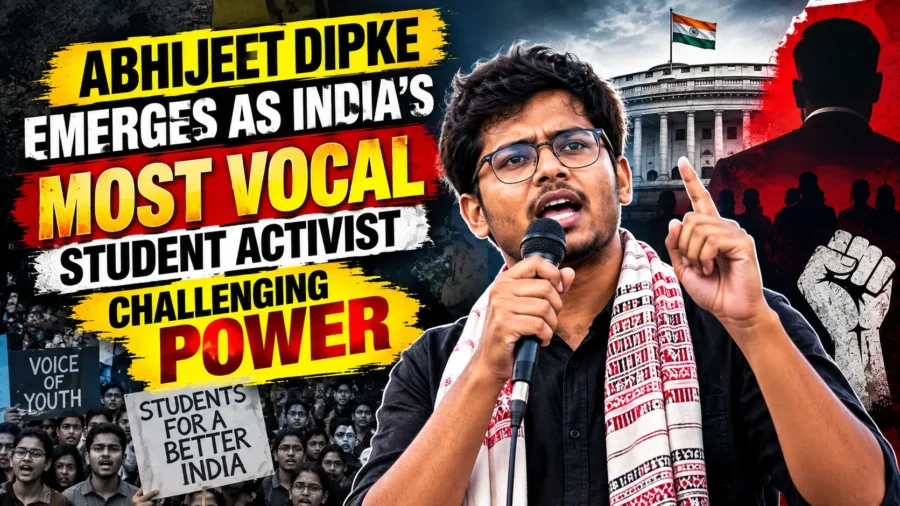

Abhijeet Dipke stands at the center of India’s most contentious political battles right now. Right there. In the thick of it. The founder of Citizens for Justice and Peace (CJP) has transformed from a student organizer into a national figure whose protests literally forced a cabinet minister to resign — and not through backroom deals or establishment pressure, but raw grassroots force. His story reveals how one determined individual can disrupt the machinery of power through sustained mobilization, the kind that doesn’t ask for permission or wait for invitations to participate in the process.
Born from the frustration of young Indians witnessing systemic failures play out in real time, Dipke’s journey began when he witnessed corruption in educational institutions firsthand. He didn’t just complain about it at chai stalls or vent on social media—he built an organization that could actually do something. CJP now operates across multiple states, documenting government failures with the kind of methodical attention that makes officials deeply uncomfortable and mobilizing citizens who feel ignored (or worse, actively dismissed) by traditional political channels. His methods combine old-school protest tactics—rallies, sit-ins, coordinated demonstrations—with digital-age transparency that makes cover-ups nearly impossible, creating a model that other activists study carefully and attempt to replicate in their own regions.
Also Read:-
Tamil Nadu Chief Minister: C. Joseph Vijay’s Bold Leadership Journey
Tamil Nadu Chief Minister: C. Joseph Vijay’s Dynamic New Leadership
The movement gained international attention when BBC profiled his role in the ‘cockroach protests’—demonstrations that ultimately led to a minister’s resignation. But that’s just one chapter. One victory in a longer campaign. The broader story encompasses education reform, systemic accountability across multiple government departments, and youth empowerment in a generation that’s increasingly skeptical about whether democratic institutions actually function. What makes Abhijeet Dipke different from previous activists is his flat-out refusal to work within establishment channels that demand patience and compromise. He doesn’t ask for meetings with officials. Instead, he creates so much pressure that meetings become inevitable — and when they finally happen, he’s negotiating from a position of demonstrated power rather than begging for scraps of attention.
The Cockroach Protests That Shook Political Establishment
When students discovered cockroaches in government-supplied food at educational institutions, most would have filed complaints through proper channels and waited. Abhijeet Dipke turned it into a nationwide symbol of administrative rot that transcended the immediate health violation. The protests he organized weren’t just about insects in rice—they represented every broken promise officials had made to parents, every diverted fund that should’ve improved conditions, every bureaucrat who treated citizens with contempt while collecting taxpayer salaries. The imagery was perfect, viscerally disgusting in a way that cut through political abstractions: something revolting that thrives exactly where cleanliness and accountability disappear.
The campaign’s brilliance lay in its elegant simplicity. Anyone could understand the problem, regardless of education level or political sophistication. Parents across economic strata felt outraged seeing pictures of the conditions their children faced daily while officials issued press releases about educational improvements. Dipke coordinated simultaneous demonstrations in multiple cities — not sequential protests that officials could address one at a time, but synchronized actions that created a sense of crisis — each one documented with photographs and testimonies that made denial impossible even for the most shameless administrator. He deployed students as investigators, gathering evidence that traditional media outlets had somehow missed or (let’s be honest) deliberately ignored because it complicated their relationships with government sources.
The minister’s resignation came after relentless pressure built over weeks, each day bringing fresh revelations. Every morning brought new documentation. And Dipke didn’t declare victory and move on to the next issue—he demanded systemic reforms to prevent recurrence, understanding that individual accountability without institutional change just means the next official will repeat the same corruption. That persistence, that refusal to accept symbolic victories, makes his activism different from performative protests that generate headlines but change nothing. He wants institutional change embedded in new processes and oversight mechanisms, not just individual accountability that lets broken systems continue functioning.
MPSC Aspirant Tragedy Exposes Government Failures
The recent suicide of an MPSC (Maharashtra Public Service Commission) aspirant in Pune triggered another major intervention by Abhijeet Dipke, who moved quickly before the official narrative could solidify. He immediately announced plans to visit the victim’s family, rejecting the government’s attempts to frame this as an isolated incident disconnected from policy failures. In statements to The Hindu and Times of India, Dipke called it ‘murder by system’—language that captures exactly how bureaucratic failures destroy lives without anyone firing a bullet or leaving fingerprints that traditional law enforcement could trace.
His analysis connects multiple dots that official statements deliberately obscure through careful language and misdirection. Paper leaks in competitive examinations have become epidemic across multiple states, destroying the dreams of honest aspirants who spend years preparing while surviving on minimal resources and family sacrifices. Unemployment rates remain catastrophically high despite government claims about economic growth that somehow never translates into actual jobs for educated young people. Young Indians face a brutal reality that their parents didn’t: work harder than any previous generation, acquire more credentials and skills, yet face fewer opportunities and less security than those who came before. When someone breaks under that pressure, when the cognitive dissonance between effort and outcome becomes unbearable, Dipke argues the system killed them as surely as if it had pushed them off a building.
The response from authorities has been defensive and dismissive in equal measure. Look at their statements. They want to treat each suicide as a personal tragedy, a mental health issue disconnected from policy choices that create impossible conditions. Dipke refuses to let them compartmentalize the crisis into individual cases that require only sympathetic press releases rather than structural reform. He’s organizing aspirant groups across Maharashtra to document the scale of paper leaks with specific evidence, the corruption in examination bodies that everyone knows exists but nobody prosecutes, and the complete absence of accountability when cheating gets exposed — because what consequences have officials actually faced? This isn’t just activism in the traditional sense—it’s investigative work that reveals what happens when institutions fail their basic functions while continuing to claim legitimacy.
Student Movements Demanding Transparent Examination Systems
The MPSC controversy highlights broader problems with India’s examination culture that affects millions annually. Millions of young people compete each year for government positions that offer security in an increasingly insecure economy where private sector jobs provide no protection. The system should reward merit and hard work — that’s the social contract that makes delayed gratification tolerable. Instead, it frequently rewards those with connections to leak sources or money to purchase questions before exams, creating a perverse incentive structure. Abhijeet Dipke has made examination reform a central demand, recognizing that young people lose faith in democracy itself when they see fairness as fiction, when the meritocracy they were promised turns out to be just another rigged game favoring the already privileged.
Defamation Battle Reveals Political Pressure Tactics
Senior Advocate Gaurav Bhatia filed a ₹2 crore defamation suit in Delhi High Court against Abhijeet Dipke and fellow CJP members Saurav Das and Ashutosh Ranka. The lawsuit, reported by Live Law and Bar & Bench, represents a classic intimidation tactic used against activists worldwide, a playbook that’s been refined over decades. File an enormous lawsuit with damages calculated to terrify, force them to spend scarce resources on legal defense instead of organizing, and hope they back down to avoid financial ruin that would destroy not just the organization but activists’ personal lives.
Now here’s the thing — Dipke’s response has been defiant rather than conciliatory. He’s treating the lawsuit as confirmation that his work threatens powerful interests who can’t defeat him through argument or evidence. If he wasn’t effective, they wouldn’t bother trying to silence him through courts that turn legal process into punishment. The case also exposes how defamation law in India can become a weapon against free speech—enormous damages claimed for criticism of public figures who should face higher scrutiny, creating a chilling effect on investigative activism that makes others think twice before challenging officials.
Legal experts watching the case note its broader implications beyond this specific dispute. If activists face financial destruction for questioning officials, what happens to accountability in a democracy? Who’ll risk their livelihood to expose corruption? The lawsuit names three CJP members, suggesting a coordinated effort to cripple the entire organization rather than address specific allegedly defamatory statements — because if this were really about specific false claims, you’d target those statements with precision rather than going after multiple individuals with crushing damages. Dipke has crowdfunded legal defense costs, turning the attack into another opportunity to build public support and demonstrate that citizens back his work with their own money, creating financial independence from establishment funding sources that always come with strings attached.
CJP Investigations Spanning Multiple States Challenge BJP Dominance
Critics have accused Abhijeet Dipke of targeting only BJP-ruled states in his school inspection campaigns, framing his accountability work as partisan opposition rather than genuine civic oversight. He hit back at Hindustan Times by citing CJP visits to Punjab and Karnataka—states governed by opposition parties—proving his movement maintains ideological consistency regardless of who holds power at the state level. The accusation itself reveals how political parties view accountability efforts as partisan attacks rather than legitimate citizen oversight that should be welcomed by any government confident in its performance.
Educational Accountability Campaign Goes National
Beyond headline-grabbing protests that dominate news cycles, Abhijeet Dipke has built a systematic approach to monitoring government schools that creates sustainable pressure. CJP teams conduct unannounced inspections (announced visits would obviously allow officials to stage-manage conditions), photograph facilities in their actual state, interview teachers and students who can describe daily realities, then publish comprehensive reports with evidence that officials cannot easily dismiss or explain away through bureaucratic language. The methodology creates documentation that has evidentiary weight — when confronted with photographic evidence of broken toilets that haven’t functioned in months, classrooms with collapsed roofs exposing students to weather, or teaching positions that remain unfilled for years while budgets claim full staffing, authorities must either fix problems or admit publicly they don’t care about children’s education.
The education campaign targets the gap between official statistics and ground reality, that space where governance becomes fiction. Government reports claim near-universal enrollment and improving facilities, painting pictures of progress. Dipke’s inspections reveal schools without functional toilets forcing children into unsanitary conditions, classrooms with collapsed roofs that make monsoon season impossible for learning, and positions that remain unfilled for years while salary budgets show full disbursement. Where’s that money going? The contrast exposes how bureaucratic reporting becomes propaganda disconnected from children’s actual experiences, creating parallel realities where official India looks nothing like the India students actually attend.
His work also highlights resource misallocation that amounts to theft. Money allocated for school improvements frequently disappears into contractor pockets through inflated bills for work never completed or completed so shoddily it fails within months. Teachers assigned to schools never show up, collecting salaries while students lose educational opportunities that can never be recovered. Dipke frames these as theft—not from government treasuries in some abstract sense, but from children’s futures in very concrete terms. That moral framing resonates with parents who understand exactly what’s being stolen: their children’s chance to escape poverty, acquire skills, build better lives than the previous generation managed.
From Student Leader to National Political Force
Abhijeet Dipke’s evolution from campus activist to national figure offers lessons for movement building that other organizers study. He started with concrete local issues—food quality that students experienced daily, examination fairness that determined their futures—that personally affected students in ways they could immediately understand. Success in those campaigns built credibility with participants and organizational capacity to handle larger operations. CJP expanded methodically, replicating proven tactics across new geographies and issue areas rather than jumping randomly to whatever seemed trendy. The organization now commands enough attention that major media outlets cover its campaigns as legitimate news and officials must respond publicly to its allegations rather than ignoring them as they would individual complainants.
What distinguishes Dipke’s approach is his rejection of traditional advocacy paths that demand working within existing power structures. He doesn’t petition authorities for reform through proper channels. He creates crises that force responses whether officials want to respond or not. When bureaucrats ignore complaints about school conditions filed through official grievance systems, he brings media teams and produces reports that embarrass the administration publicly, making inaction politically costly. When examination authorities dismiss paper leak allegations as rumors from disgruntled candidates, he organizes aspirants to document evidence systematically and demand prosecutions that can’t be quietly buried. This confrontational style makes enemies, which explains the defamation lawsuits and political attacks that seek to destroy him before he becomes too powerful to ignore.
The movement’s sustainability depends on continuous mobilization, which creates exhausting demands. Dipke can’t rely on established institutions—courts that move slowly, media that chases different stories each week, political parties with their own agendas—to amplify citizen concerns without constant pressure. CJP must generate its own attention through actions that break through information overload in an environment where everyone’s competing for public attention. That requires immense energy and resources, which is why most activist movements eventually burn out as key organizers exhaust themselves or get absorbed into establishment politics where confrontation becomes negotiation. Whether Abhijeet Dipke can maintain independence and intensity over years rather than months remains an open question that will determine whether this becomes a sustained force or another flash of protest that fades.
Legal Challenges and Political Controversy Follow Activist Work
A criminal complaint was recently filed against Abhijeet Dipke alongside comedian Kunal Kamra and activist Sonam Wangchuk, as reported by The Tribune. The court was urged to send the plaint to Delhi police for investigation. Such complaints represent another tactic to harass activists—tie them up in multiple legal proceedings across different jurisdictions, forcing them to spend time and money defending actions that should be protected speech, appearing in courts scattered across the country for cases that may never reach trial but serve their purpose through process itself.
Frequently Asked Questions
Who is Abhijeet Dipke and why is he significant?
Abhijeet Dipke is the founder of Citizens for Justice and Peace (CJP), a grassroots activist organization that has gained national prominence for holding government officials accountable. He rose to fame through the ‘cockroach protests’ that exposed food quality issues in educational institutions and ultimately forced a minister’s resignation. His significance lies in his ability to mobilize student movements that create real political consequences through sustained pressure and documentation of systemic failures.
What are the cockroach protests that made Dipke famous?
The cockroach protests were demonstrations organized by Abhijeet Dipke after students discovered insects and substandard food in government-supplied meals at educational institutions. Rather than treating this as an isolated incident, Dipke turned it into a symbol of widespread administrative corruption and negligence. The protests gained momentum through coordinated actions across multiple cities, extensive documentation, and media coverage that made ignoring the issue politically impossible. The campaign resulted in a cabinet minister’s resignation and sparked broader conversations about accountability in education.
Why did an MPSC aspirant’s death involve Abhijeet Dipke?
When an MPSC (Maharashtra Public Service Commission) aspirant died by suicide in Pune, Abhijeet Dipke publicly called it ‘murder by system’ and announced plans to visit the family. He connected the tragedy to systemic issues including rampant paper leaks in competitive examinations, chronic unemployment, and government failures to protect honest aspirants. Dipke rejected official attempts to frame the death as an isolated mental health issue, instead organizing aspirant groups to document widespread corruption in examination systems.
What is the defamation case against Abhijeet Dipke about?
Senior Advocate Gaurav Bhatia filed a ₹2 crore defamation suit in Delhi High Court against Abhijeet Dipke and fellow CJP members Saurav Das and Ashutosh Ranka. The lawsuit represents a common intimidation tactic used against activists—filing enormous damage claims to create financial pressure and force activists to back down. Dipke has treated the lawsuit as confirmation that his work threatens powerful interests, and has crowdfunded legal defense costs while continuing his activism.
Does Abhijeet Dipke only target BJP-ruled states?
No. While critics have made this accusation, Abhijeet Dipke specifically cited CJP’s inspection visits to Punjab and Karnataka—both governed by opposition parties—to demonstrate that his organization maintains ideological consistency regardless of which party holds power. CJP’s school inspection campaigns and accountability efforts focus on systemic failures rather than partisan politics, though the confrontational nature of his work inevitably creates political controversy.
What is Citizens for Justice and Peace (CJP)?
Citizens for Justice and Peace (CJP) is a grassroots activist organization founded by Abhijeet Dipke that focuses on holding government institutions accountable through direct action, documentation, and public mobilization. The organization conducts unannounced school inspections, organizes protests around systemic failures, and produces detailed reports that expose gaps between official claims and ground reality. CJP operates across multiple Indian states and has become known for its confrontational approach that creates political pressure rather than working through traditional advocacy channels.
What educational qualifications does Abhijeet Dipke have?
While specific educational credentials are not extensively detailed in available sources, Abhijeet Dipke emerged from student activism circles and built his reputation through organizing work rather than academic credentials. His qualification lies primarily in his demonstrated ability to mobilize movements, document systemic failures, and create political pressure that produces tangible results—skills he developed through years of grassroots organizing.
Has Abhijeet Dipke faced health issues during protests?
Questions have circulated about whether Abhijeet Dipke fainted during protests, though specific confirmed incidents are not detailed in current reporting. Such questions often arise around activists who engage in hunger strikes or sustained demonstrations. Regardless of specific health incidents, Dipke’s activism involves physically demanding work including extensive travel for inspections, organizing rallies, and maintaining a punishing schedule of public appearances.
| Key Aspect | Details |
|---|---|
| Organization Founded | Citizens for Justice and Peace (CJP) |
| Major Campaign | Cockroach Protests (Food Quality in Educational Institutions) |
| Political Impact | Forced Cabinet Minister’s Resignation |
| Recent Focus | MPSC Examination Reforms, Paper Leak Documentation |
| Legal Challenges | ₹2 Crore Defamation Suit by Gaurav Bhatia |
| Operational Scope | Multiple Indian States (Including Punjab, Karnataka, Maharashtra) |
| Primary Method | Unannounced Inspections, Documentation, Public Mobilization |
| Media Coverage | BBC, The Hindu, Times of India, Hindustan Times |