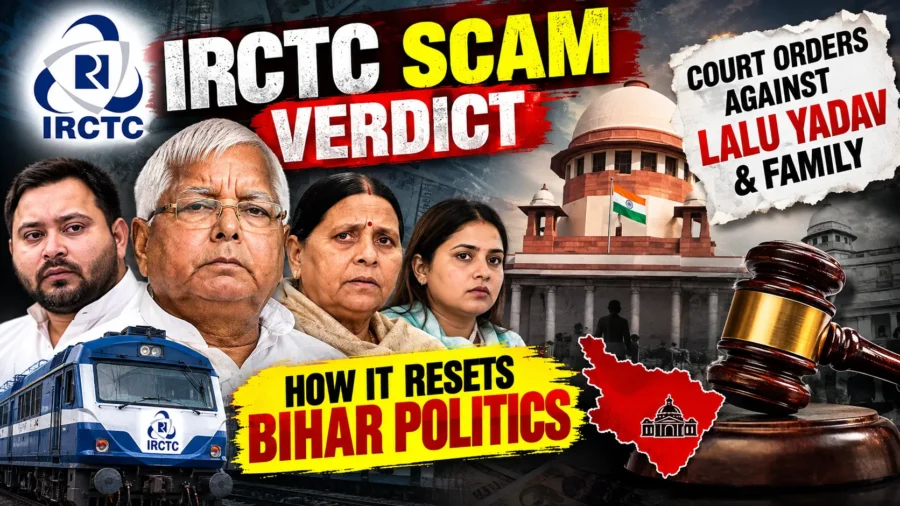

IRCTC case developments shook India’s political landscape on September 11, 2026, when a Delhi court ordered the framing of money laundering charges against Rashtriya Janata Dal (RJD) supremo Lalu Prasad Yadav, his wife Rabri Devi, and son Tejashwi Yadav. Big moment. The decision marks a critical juncture in one of India’s longest-running corruption investigations, involving alleged irregularities in awarding Indian Railway Catering and Tourism Corporation (IRCTC) hotel management contracts during Lalu’s tenure as Railway Minister between 2004 and 2009. This legal development arrives at a politically sensitive moment — potentially influencing Bihar’s electoral dynamics and the broader opposition coalition’s unity ahead of national elections, which are barely months away now. And that’s not all. Beyond the immediate legal ramifications, this IRCTC judgment sets a precedent for how corruption allegations involving high-profile political families will be pursued through India’s complex investigative machinery, creating ripples that’ll affect power equations in several states where caste arithmetic and dynasty politics remain dominant forces in electoral calculations.
The court’s directive follows years of investigation by the Enforcement Directorate (ED) into allegations that Lalu Prasad Yadav, while serving as Railway Minister, awarded hotel management contracts to a private firm in exchange for prime land in Patna transferred to his family members at significantly below-market rates. The judge noted “strong suspicion” warranting formal charges under the Prevention of Money Laundering Act (PMLA), suggesting prima facie evidence of proceeds of crime being laundered through property transactions — a legal threshold that’s difficult to meet without substantial documentary proof. Beyond the Yadav family, six other accused individuals will face trial, indicating the investigation has uncovered what prosecutors describe as a systematic quid pro quo arrangement involving public office misuse. Why does this matter? Because it transforms what might’ve been dismissed as routine political vendetta into a case where evidentiary standards appear robust enough to survive preliminary judicial scrutiny. The judge’s observations specifically referenced discrepancies between market valuations and actual transaction prices, corporate shareholding patterns that suggested coordinated activity, and communication records that prosecutors claim establish intent to conceal the true nature of financial flows between railway contract beneficiaries and the minister’s family entities.
Also Read:-
Tamil Nadu Chief Minister: C. Joseph Vijay’s Bold Leadership Journey
Tamil Nadu Chief Minister: C. Joseph Vijay’s Dynamic New Leadership
Why This Enforcement Directorate Investigation Refuses to Close
The IRCTC hotel scam investigation has persisted for over 17 years. That’s nearly two decades. Demonstrating the complexity of financial crime prosecutions in India’s judicial system, this case has outlasted three different governments at the center, survived multiple changes in enforcement agency leadership, and weathered countless political storms that might’ve buried less documented allegations. Central to the case is an alleged conspiracy where IRCTC awarded management rights for two hotels — one in Ranchi and another in Puri — to a company called Sujata Hotels Private Limited in 2006, during a period when Lalu Prasad Yadav wielded enormous discretionary power over railway commercial decisions. Investigators claim this contract award was irregular because Lalu Prasad Yadav’s family received valuable commercial land in Patna’s Bailey Road area through shell companies controlled by the hotel firm’s directors. The land transfer occurred at approximately Rs 400 per square foot when market rates hovered around Rs 10,000 per square foot, representing what the ED characterizes as disguised kickbacks totaling several crore rupees — a valuation gap so enormous that it defies explanation through ordinary commercial negotiations or market timing advantages.
What makes this investigation particularly tenacious is the paper trail connecting three distinct transactions. Look, prosecutors didn’t just stumble onto suspicious coincidences; they’ve painstakingly documented the IRCTC contract award, land purchases by Delight Marketing Company (allegedly controlled by Rabri Devi and the couple’s daughters), and subsequent property development that significantly increased asset values over the following decade. Forensic accountants traced fund flows through multiple corporate entities, revealing intricate layering techniques designed to obscure the original source of money — techniques that mirror classic money laundering methodologies described in international financial crime literature. The Enforcement Directorate’s case rests on establishing that these land acquisitions constituted proceeds of crime — specifically, bribes received in exchange for favorable treatment in railway contract allocations, creating a direct nexus between ministerial discretion and family enrichment that’s legally prohibited under both corruption and money laundering statutes. Documents submitted to the court detail board resolutions, share transfer agreements, and property registration records spanning 2004 to 2014, creating a comprehensive timeline that prosecutors argue demonstrates deliberate criminal intent rather than legitimate business transactions that happened to benefit politically connected individuals through fortunate timing or shrewd negotiation.
The legal proceedings have survived multiple bail applications, discharge petitions, and jurisdictional challenges. Remarkably resilient, this case has weathered defense arguments that might’ve derailed weaker prosecutions built on circumstantial foundations. The Supreme Court ultimately upheld the Enforcement Directorate’s authority to investigate money laundering aspects independently of the Central Bureau of Investigation’s (CBI) parallel corruption case — a jurisdictional ruling that clarified ambiguities about whether two agencies could simultaneously pursue different statutory violations arising from the same factual matrix. This separation of investigative agencies has created dual legal jeopardy for the accused, though it also ensures that financial crime aspects receive specialized attention from enforcement officers trained specifically in tracing illicit fund flows through complex corporate structures. The court’s recent order to frame charges represents a procedural milestone, transitioning the case from the investigation and evidence assessment phase to actual trial, where witnesses will testify under oath and documentary evidence will face rigorous cross-examination under criminal procedure rules that favor defendants. And here’s the thing — once charges are framed, the prosecution bears the burden of proving guilt beyond reasonable doubt, a significantly higher standard than the prima facie case required for framing charges, meaning the real battle is only now beginning despite nearly two decades of investigation.
How Family Members Found Themselves Entangled in Railway Contracts
Rabri Devi and Tejashwi Yadav’s involvement in the IRCTC case stems from their alleged roles in receiving and managing proceeds from the irregular hotel contracts. According to the charge sheet, Rabri Devi held controlling interests in Delight Marketing Company when it purchased the disputed Patna land parcels — corporate records showing her as a director and significant shareholder during the relevant period when these valuable properties changed hands at suspiciously low prices. While Tejashwi, though younger during the relevant period (he’d have been barely in his early twenties when the alleged transactions occurred), later became associated with property development on these sites, raising questions about whether he knowingly benefited from his parents’ alleged corrupt activities or was simply a beneficiary unaware of the properties’ tainted origins. Prosecutors contend that family members served as conduits for laundering bribe money, converting illicit gains into ostensibly legitimate real estate holdings that could generate rental income and capital appreciation over time — a classic wealth preservation strategy that transforms one-time corrupt payments into enduring assets that appear lawful on their face.
The inclusion of family members in money laundering cases reflects evolving legal strategies in India where enforcement agencies increasingly target not just the primary accused public official but also relatives who allegedly benefited from corruption proceeds. This approach aligns with PMLA provisions that criminalize not only the generation of illicit funds but also their concealment, possession, or use, regardless of whether the person handling the money directly participated in the predicate offense — a legislative framework that’s controversial because it can ensnare individuals who may not have known about the criminal origins of assets they received or managed. For Tejashwi Yadav, currently serving as Deputy Chief Minister of Bihar in the opposition coalition government, these charges carry significant political implications. Big ones. Potentially affecting his credibility as a corruption-fighting leader who has positioned himself as representing a new generation of clean politics, someone who’d transcended his father’s checkered legacy and offered Bihar voters a fresh start grounded in development rather than dynasty. But how credible is that narrative when you’re facing money laundering charges connected to your family’s alleged enrichment through your father’s ministerial discretion?
What the Amended Money Laundering Regulations Mean for Accused Politicians
Recent amendments to India’s anti-money laundering framework have strengthened prosecution capabilities while creating stricter bail conditions for accused individuals — changes that’ve generated fierce debate about whether they appropriately combat financial crime or unconstitutionally tilt the playing field against defendants before any finding of guilt. The PMLA now allows attachment of properties even before formal charges are framed, a provision the Enforcement Directorate has utilized extensively in this case by freezing assets allegedly purchased with corrupt proceeds, effectively depriving accused individuals of access to wealth they claim was legitimately earned and lawfully acquired. These regulatory changes shift the burden of proof regarding legitimate income sources to the accused, requiring them to demonstrate that acquired properties were purchased through documented, taxed income rather than criminal proceeds — a challenging evidentiary standard when dealing with complex corporate structures and historical transactions where original documentation may have been lost, destroyed, or never comprehensively maintained in the first place.
For politicians facing PMLA charges, the law’s stringent bail provisions create additional pressure that goes well beyond typical criminal prosecutions. Courts typically refuse bail unless the accused can establish prima facie that they’re not guilty and unlikely to commit offenses while on bail — a reverse onus clause that critics argue violates presumption of innocence principles enshrined in constitutional jurisprudence and international human rights conventions that India has ratified. In Lalu Prasad Yadav’s case, previous bail applications in related corruption cases (particularly the infamous fodder scam prosecutions that resulted in convictions and imprisonment) have been rejected or granted only after prolonged incarceration, suggesting that securing pre-trial liberty in this IRCTC matter will prove equally difficult given the pattern of judicial skepticism about flight risk and evidence tampering concerns when powerful political figures face serious charges. The framing of charges also triggers asset attachment provisions automatically under current PMLA interpretations, potentially freezing properties worth hundreds of crores until trial conclusion — which could easily be a decade away given India’s backlogged court system — creating financial hardship and operational difficulties for business entities controlled by accused individuals who may be innocent but face economic strangulation pending vindication.
Where Political Careers Meet Courtroom Accountability
The timing of charge framing in the IRCTC scam intersects critically with Bihar’s political calendar and national opposition unity efforts. Coincidence? Maybe, though opposition leaders certainly don’t think so. Lalu Prasad Yadav, despite health issues stemming from his advanced age and previous convictions in fodder scam cases that resulted in imprisonment and damaged his physical well-being, remains the ideological anchor of RJD and a key architect of opposition alliances in eastern India — a political tactician whose influence extends far beyond his party’s organizational boundaries. His legal troubles create succession questions within the party, though Tejashwi Yadav has emerged as the de facto leader, steering RJD through recent assembly elections and coalition negotiations with considerable political skill that initially suggested he might escape his father’s controversial shadow. However, Tejashwi’s own inclusion in the IRCTC charges complicates this transition, raising questions about whether corruption allegations will undermine the party’s electoral appeal or galvanize supporters who view these cases as politically motivated persecution designed to decapitate opposition leadership ahead of crucial electoral contests where anti-incumbency sentiment might otherwise favor the RJD-led coalition.
For the ruling coalition at the national level, these developments provide ammunition to question opposition leaders’ moral authority to challenge government corruption. Political analysts note that corruption cases against opposition figures often see accelerated progress during election seasons, though courts maintain independence in judicial decision-making and scheduling that’s theoretically insulated from executive pressure or political considerations. The RJD has consistently characterized these investigations as vendetta politics, arguing that selective prosecution targets opposition leaders while ignoring alleged corruption by ruling party figures whose misdeeds supposedly go uninvestigated despite media exposés and civil society complaints that would’ve triggered enforcement action if directed at opposition politicians. This narrative resonates with segments of Bihar’s electorate who view Lalu Prasad Yadav as a champion of backward caste empowerment despite his legal troubles — a leader who delivered dignified representation to communities historically marginalized by upper-caste political dominance, making his personal failings seem less important than his symbolic significance. It creates complex voter calculus where governance failures and corruption allegations compete with identity politics and social justice messaging that frames legal proceedings as efforts by entrenched elites to delegitimize leaders who challenged casteist hierarchies.
The case also highlights broader systemic issues in Indian politics regarding the nexus between business interests and political power. Railway contracts, particularly those involving hospitality and catering services, have historically been plagued by allegations of favoritism and kickbacks due to their high value and discretionary nature — opportunities for rent-seeking that exist because transparent competitive processes are often subverted through technical specifications tailored to preferred vendors or evaluation criteria manipulated to predetermine outcomes. The IRCTC case exemplifies how ministerial discretion in contract awards can potentially be exploited for personal enrichment when adequate transparency mechanisms and competitive bidding processes are absent or subverted through bureaucratic complexity that obscures decision-making from public scrutiny. Reform advocates argue that this case should prompt comprehensive changes in how government contracts are awarded, including mandatory disclosures of beneficial ownership in companies bidding for public contracts, stricter conflict-of-interest rules that disqualify firms with family connections to decision-makers, and technological solutions like e-procurement platforms that reduce human discretion in vendor selection by automating compliance checks and creating audit trails that can’t be easily manipulated after the fact.
When Clean Politics Campaigns Collide With Corruption Allegations
Tejashwi Yadav’s political rise has been built substantially on anti-corruption messaging and promises of transparent governance. Ironic, right? Making his inclusion in the IRCTC case particularly damaging to his carefully cultivated image as a reformer who’d learned from his father’s mistakes rather than repeating them. During Bihar assembly elections, he effectively used allegations of corruption against rival political leaders to mobilize youth voters and urban constituencies traditionally skeptical of caste-based parties — demographics that responded enthusiastically to his promises of employment generation, educational reform, and meritocratic governance that’d reward competence rather than political connections. The irony of facing similar charges himself creates cognitive dissonance that political opponents are eager to exploit, questioning the credibility of his governance promises and positioning him as a product of dynastic politics who inherited not just political legacy but also alleged corrupt practices from his father, benefiting materially from the very ministerial misconduct he now claims to oppose philosophically.
However, the RJD’s response strategy has focused on distinguishing between allegations and convictions. Important distinction. Emphasizing that charges don’t constitute proof of guilt and that legal proceedings must be allowed to reach conclusion without prejudgment — a legally sound argument that’s nonetheless politically difficult to sustain when media coverage and opposition rhetoric treat charges as tantamount to conviction. Party spokespersons point out that Tejashwi Yadav was barely in his twenties during the relevant period (2004-2009) and had no official role in government or party decision-making at that time, suggesting his inclusion is an attempt to create collective family liability for transactions he neither initiated nor controlled, a prosecutorial overreach that conflates familial association with criminal culpability. This defense resonates with supporters who view the extended Yadav family as victims of caste-based political targeting — an interpretation that frames enforcement actions as upper-caste establishment attempts to prevent backward caste leaders from accumulating generational wealth that could fund long-term political competition. But it struggles to explain the documented property holdings and corporate connections that form the basis of prosecution evidence, particularly records showing Tejashwi’s subsequent involvement in developing properties allegedly purchased with laundered bribe money, which prosecutors argue demonstrates knowing benefit from criminal proceeds even if he wasn’t involved in the original corrupt transaction.
What Food Safety Violations at IRCTC Facilities Reveal About Operations
In a separate but contemporaneous development highlighting operational challenges at IRCTC-linked facilities, Maharashtra’s Food and Drug Administration (FDA) suspended licenses for an IRCTC-connected kitchen and three ISKCON food outlets in Mumbai after inspections revealed serious hygiene violations. Disturbing findings. Officials discovered cockroach infestations, rodent droppings, and improper food storage practices at these commercial kitchens that supply meals to railway passengers and restaurant chains — violations that pose direct public health risks to potentially millions of consumers who trust that food served through established brands meets basic sanitation standards. The FDA action resulted in immediate suspension of three ISKCON outlet licenses and cancellation of permits for an IRCTC supplier, affecting meal services on several train routes originating from Mumbai and creating logistical challenges for railway catering operations that now must identify alternative suppliers on short notice during peak travel season.
| Facility | Location | Violations Found | Regulatory Action |
|---|---|---|---|
| IRCTC Supplier Kitchen | Mumbai Central | Rodent infestation, inadequate cold storage | License canceled immediately |
| ISKCON Outlet – Juhu | Juhu, Mumbai | Cockroach presence, expired ingredients | License suspended for 30 days |
| ISKCON Outlet – Chowpatty | Chowpatty, Mumbai | Unhygienic preparation area, pest control failures | License suspended for 30 days |
| ISKCON Outlet – Mira Road | Mira Road, Mumbai | Contaminated water supply, improper waste disposal | License suspended for 30 days |
These food safety violations, while unrelated to the corruption case, compound IRCTC’s reputational challenges and raise questions about quality control mechanisms in contracted services. The organization has faced recurring technical issues with its online booking platform, with users frequently encountering “Unable to Process” error messages during peak booking periods — frustrating experiences that drive customers to third-party travel aggregators or unauthorized agents despite IRCTC’s official monopoly on railway ticket sales. These operational failures stem from inadequate server capacity relative to demand spikes during festival seasons and special fare announcements, when millions of users simultaneously attempt to book train tickets in a digital stampede that overwhelms infrastructure designed for average traffic rather than peak loads. Technical experts note that IRCTC’s IT infrastructure has struggled to scale with growing user demand, despite the organization generating substantial revenue from convenience fees, cancellation charges, and tourism package sales — financial resources that theoretically could’ve funded infrastructure upgrades but apparently were allocated elsewhere or consumed by operational inefficiencies. And what does this reveal? That IRCTC’s operational excellence doesn’t match its regulatory privilege, creating vulnerability if policy changes ever open railway ticketing to competition from platforms with superior technological capabilities and customer service standards.
Why Business Moat Analysis Matters for IRCTC Investors
From an investment perspective, the IRCTC case and operational challenges provide important lessons about the difference between regulatory monopolies and sustainable competitive advantages. IRCTC operates India’s sole authorized platform for online railway ticket booking, creating an apparent moat that theoretically protects market share and pricing power from competitive erosion. However, financial analysts increasingly recognize that this moat is narrow and vulnerable to both regulatory changes and operational execution failures — factors that could evaporate the company’s privileged position far more quickly than traditional competitive threats would undermine an organically developed market leadership position. The government retains authority to modify IRCTC’s exclusive ticket sales rights, potentially opening the market to competing platforms or eliminating convenience fees that contribute significantly to profitability, regulatory changes that could be implemented through simple policy notifications without requiring legislative approval or prolonged bureaucratic processes.
Recent market performance reflects investor concerns about both regulatory risk and corruption allegations affecting IRCTC’s parent ministry. Share price volatility has increased following each development in the scam case, suggesting markets price in governance risk premiums for companies with close political connections — a discount reflecting uncertainty about whether political transitions or corruption scandals will trigger policy changes adverse to the company’s business model. Investment analysts warn that businesses dependent on government contracts or regulatory protection face inherent risks from policy changes, particularly when corruption allegations emerge involving officials who awarded those privileges, creating political pressure to revisit arrangements that appear tainted by favoritism or improper influence. For IRCTC specifically, the corruption case highlights how political transitions can affect corporate fortunes, with new governments potentially revisiting contractual arrangements made by predecessors, especially those tainted by scandal — a political economy reality that’s distinct from normal competitive dynamics and difficult to model in traditional valuation frameworks.
The company’s attempt to diversify beyond ticketing into tourism packages, hospitality services, and rail neer (packaged drinking water) represents recognition that exclusive ticketing rights can’t indefinitely sustain growth trajectories that justify premium market valuations. However, these expansion efforts have encountered implementation challenges and intense competition from established players in hospitality and packaged goods sectors who don’t face the bureaucratic constraints and political oversight that limit IRCTC’s operational flexibility. The food safety violations at contracted kitchens exemplify execution risks in service quality maintenance when operations scale rapidly across diverse geographies without commensurate investment in monitoring systems and quality assurance protocols. Investors evaluating IRCTC must therefore look beyond the superficial moat of booking monopoly to assess management quality, technological capabilities, regulatory relationships, and operational excellence — factors where the company’s track record presents mixed signals that complicate investment theses based solely on the durability of its ticketing franchise.
How Legal Proceedings Will Unfold Over Coming Months
Following the court’s order to frame charges, the IRCTC case now enters the trial phase. Here’s what happens next. Prosecution must prove allegations beyond reasonable doubt through witness testimony and documentary evidence — a significantly higher standard than the prima facie case that sufficed for framing charges. Legal experts anticipate proceedings will extend over several years given the complexity of financial transactions, the number of accused individuals (nine people facing charges creates logistical complexity in scheduling hearings when all parties and their counsel must be present), and the likelihood of extensive cross-examination and procedural challenges that’ll consume countless hearing dates. The accused parties have the right to appeal the charge-framing order to higher courts, potentially delaying the trial’s commencement by months or even years, though higher courts typically decline to interfere with such orders unless procedural irregularities are apparent or the evidence is so deficient that framing charges constituted judicial error.
The trial will involve examining hundreds of documents. Thousands, probably. Including board minutes from companies allegedly used as shell entities, share transfer agreements showing changes in corporate ownership, property registration records documenting land transactions at the heart of the alleged quid pro quo, banking transactions tracing fund flows between parties, and communications between alleged co-conspirators that prosecutors will argue demonstrate coordination and criminal intent. Prosecution witnesses will likely include IRCTC officials who participated in contract award decisions (some potentially testifying reluctantly under subpoena, others perhaps cooperating in exchange for immunity from prosecution), property registration authorities who recorded land transfers and can authenticate official documents, forensic accountants who traced fund flows through complex corporate structures and will explain financial analysis methodologies to judges unfamiliar with sophisticated money laundering techniques, and potentially cooperating witnesses who may have turned approvers in exchange for reduced charges — though such witnesses face credibility challenges during cross-examination. Defense strategy will probably focus on challenging the prosecution’s ability to prove criminal intent beyond mere suspicious coincidence, arguing that business transactions were legitimate and properly documented with all corporate formalities observed, and questioning the Enforcement Directorate’s interpretation of complex corporate arrangements as money laundering rather than standard commercial practices that sophisticated investors routinely employ for tax planning and asset protection purposes.
For the Yadav family, the trial represents not merely legal jeopardy but political vulnerability extending through multiple electoral cycles. Conviction would disqualify Lalu Prasad Yadav from contesting elections (though he’s already disqualified due to previous convictions that resulted in sentences exceeding two years, making this particular consequence redundant for him personally) and potentially impact Tejashwi’s political future depending on sentence severity and appellate outcomes — a two-year sentence would trigger automatic disqualification, while anything less might allow continued political activity albeit with significant reputational damage. Even acquittal after years of trial would leave residual reputational damage and consume political capital that could otherwise be deployed for governance and electoral mobilization, transforming scarce leadership bandwidth from policy development and coalition management to legal defense coordination and damage control messaging. This reality explains the intensity of political rhetoric surrounding the case, with opposition parties characterizing it as weaponization of investigative agencies by an authoritarian government intolerant of dissent, while ruling coalition members emphasize the importance of holding corrupt politicians accountable regardless of their stature or political affiliations — competing narratives that’ll shape public perception of the trial’s legitimacy regardless of its ultimate legal outcome.
Frequently Asked Questions
What exactly is the IRCTC scam case about?
The IRCTC scam case involves allegations that Lalu Prasad Yadav, during his tenure as Railway Minister from 2004 to 2009, awarded hotel management contracts for IRCTC properties to a private company in exchange for valuable land in Patna being transferred to his family members at below-market rates. The Enforcement Directorate contends this constituted money laundering, with illicit proceeds being disguised through shell companies and property transactions. The case examines whether the land acquisitions represented bribes for favorable treatment in railway contract awards.
Who are all the accused individuals in this case?
The Delhi court has ordered charges to be framed against nine individuals: Lalu Prasad Yadav (former Railway Minister), Rabri Devi (his wife and former Bihar Chief Minister), Tejashwi Yadav (their son and current Deputy Chief Minister of Bihar), and six other individuals allegedly connected to the shell companies and property transactions. These additional accused include business associates and corporate entities that prosecutors claim served as intermediaries in laundering the alleged bribe money through real estate investments.
How does the Prevention of Money Laundering Act apply to this case?
The PMLA makes it criminal to acquire, possess, or use property derived from criminal activity, even if the person handling the proceeds didn’t commit the original crime. In this case, the ED alleges that land purchases by Lalu Yadav’s family members constitute laundering of bribe money received in exchange for IRCTC contracts. The law allows authorities to attach and potentially confiscate properties deemed proceeds of crime, creates reverse burden of proof regarding legitimate income sources, and imposes stringent bail conditions that make pre-trial release difficult for accused individuals.
What happens now that charges have been framed?
Charge framing marks the formal beginning of trial proceedings. The court will now schedule hearing dates where prosecution presents evidence through witness testimony and documents. The accused have the right to cross-examine witnesses, present their own evidence, and argue that prosecution hasn’t proven guilt beyond reasonable doubt. This process typically extends over several years in complex financial crime cases. The accused can also appeal the charge-framing order to higher courts, though this rarely results in charges being dropped at this stage.
Why did the FDA suspend licenses for IRCTC and ISKCON food facilities?
Maharashtra’s Food and Drug Administration conducted surprise inspections at commercial kitchens supplying food to IRCTC trains and ISKCON restaurant chains, discovering serious hygiene violations including cockroach infestations, rodent droppings, expired ingredients, inadequate cold storage, and contaminated water supplies. These findings represent violations of food safety regulations that mandate pest control, proper storage temperatures, and sanitary preparation conditions. The FDA immediately suspended licenses to protect public health until facilities remediate violations and pass reinspection.
How do these corruption allegations affect IRCTC as a company?
While the corruption allegations primarily involve individuals rather than IRCTC as an organization, the case creates reputational risk and highlights governance concerns in contract award processes. The revelations may prompt policy changes in how railway contracts are awarded, potentially affecting IRCTC’s business relationships. Investor sentiment has been negatively impacted by association between corruption allegations and the ministry that oversees IRCTC, contributing to stock price volatility. However, the company’s day-to-day operations continue normally, and the ticketing platform remains India’s exclusive authorized booking channel for train reservations.
What is the typical timeline for such cases to reach verdict?
Financial crime cases in India typically take five to ten years from charge sheet filing to trial court verdict, with additional years for appellate proceedings if either side challenges the judgment. Complex money laundering cases involving multiple accused, hundreds of documents, and intricate financial transactions tend toward the longer end of this range. Given that the IRCTC investigation began in the early 2010s and is only now entering trial phase, a final non-appealable verdict is unlikely before 2030-2032, assuming no unusual delays or expedited hearing procedures.
Can politicians contest elections while facing criminal charges?
Current Indian law doesn’t prohibit individuals from contesting elections merely because they face criminal charges, even serious ones like money laundering. Candidates must disclose pending cases when filing nomination papers, but voters can still elect them. However, conviction and sentencing of two years or more imprisonment results in automatic disqualification from holding elected office and a six-year ban on contesting elections. This distinction explains why politicians can continue electoral activities while fighting charges but face immediate political consequences upon conviction, creating strong incentives to delay trial proceedings through legal challenges.