
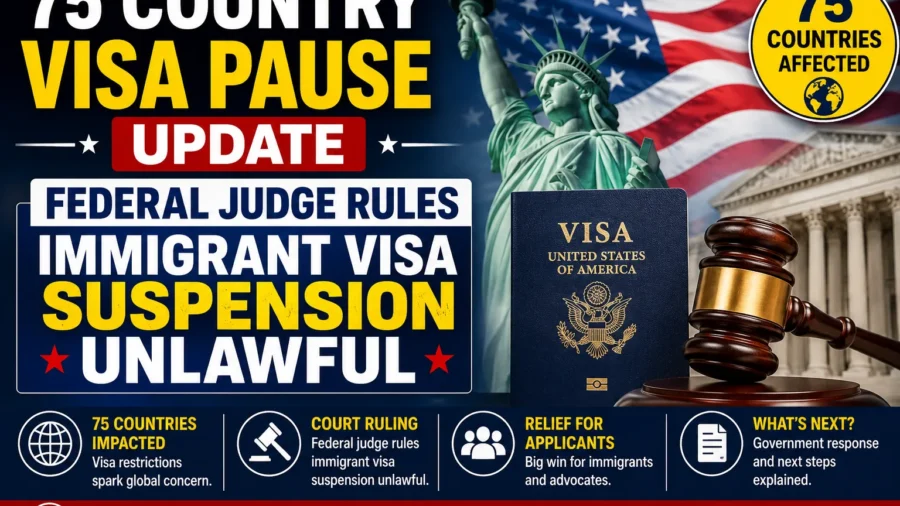
Policy: U.S. immigrant visa suspension for nationals of 75 countries Announced: 14 January 2026 Took Effect: 21 January 2026 Latest Update: 21 August 2026 — federal judge rules the policy unlawful Issued By: U.S. Department of State
The 75 country visa pause has taken a major turn. Nearly seven months after the U.S. Department of State froze immigrant visa issuance for applicants from 75 countries, a federal judge has ruled that the policy is unlawful — making this the most significant 75 country visa pause update since the freeze first began. Here is a complete, easy-to-follow breakdown of what the original policy said, what has changed, which countries are affected, and what applicants need to know now.
Quick Snapshot
| Detail | Information |
|---|---|
| Policy Name | Immigrant Visa Processing Pause for 75 Countries |
| Announced By | U.S. Department of State |
| Announcement Date | 14 January 2026 |
| Effective Date | 21 January 2026 |
| Visa Types Affected | Immigrant visas only (green card pathway) |
| Visa Types NOT Affected | Non-immigrant visas (F-1, J-1, H-1B, O-1, B-1, etc.) |
| Stated Reason | “Public charge” / welfare-dependency risk concerns |
| Number of Countries Affected | 75 |
| Latest Court Ruling | 21 August 2026 |
| Judge | U.S. District Judge Jeanette A. Vargas (SDNY) |
| Case Name | CLINIC v. Rubio |
| Ruling Outcome | Policy found to violate the Immigration and Nationality Act (INA) |
What Is the 75 Country Visa Pause?
The 75 countries visa pause refers to a policy first announced on 14 January 2026, under which the U.S. Department of State directed all consular posts worldwide to stop issuing immigrant visas — the visas that lead to a green card and permanent residence — to nationals of 75 designated countries. The pause took effect on 21 January 2026 and was described by the State Department as indefinite, remaining in place “until the U.S. can ensure that new immigrants will not extract wealth from the American people,” citing concerns about applicants becoming a “public charge.”
Importantly, the pause applied only to immigrant visas. Non-immigrant visas — including F-1 (student), J-1 (exchange visitor), H-1B (specialty worker), O-1, B-1/B-2 (business/tourist), and similar categories — were never affected by this policy, and holders of those visas continued to travel and work normally.
Also Read :-
Michael Wright Death: ‘The Five Heartbeats’ Actor Passes Away at 70 — Everything We Know
7 Powerful Delta Airlines Updates You Need to Know
Which Countries Were Included in the 75 Country Visa Pause?
The affected countries span Africa, Asia, the Caribbean, Eastern Europe, and Latin America. Some of the major countries on the list include:
| Region | Example Countries Affected |
|---|---|
| Africa | Nigeria, Ghana, Ethiopia, Somalia, Sudan, Uganda, Rwanda, Egypt, Morocco, Tunisia, Libya |
| Asia | Afghanistan, Pakistan, Bangladesh, Nepal, Cambodia, Laos, Mongolia, Kazakhstan |
| Middle East | Iran, Iraq, Syria, Lebanon, Jordan, Kuwait |
| Caribbean | Haiti, Jamaica, Cuba, Dominica, Saint Lucia |
| Latin America | Brazil, Guatemala, Nicaragua, Colombia, Uruguay |
| Eastern Europe / Balkans | Russia, Belarus, Georgia, Armenia, Azerbaijan, Kosovo, Albania |
This is a representative sample; the complete official list of all 75 countries is published on the U.S. Department of State’s travel.state.gov website.
Timeline: How the 75 Country Visa Pause Unfolded
| Date | Event |
|---|---|
| 14 January 2026 | State Department announces pause on immigrant visas for 75 countries |
| 21 January 2026 | Policy officially takes effect |
| 2 February 2026 | Catholic Legal Immigration Network (CLINIC) and others file lawsuit against Secretary of State Marco Rubio (CLINIC v. Rubio) in the U.S. District Court, SDNY |
| 26 March 2026 | State Department files brief opposing plaintiffs’ motion for summary judgment |
| 31 July 2026 | In a related case (De Moura Gomes v. Rubio), Judge Amit Mehta rules the policy exceeded the Secretary of State’s authority, but grants only narrow, individual relief without striking down the policy nationwide |
| 21 August 2026 | Judge Jeanette A. Vargas rules in CLINIC v. Rubio that the policy violates the Immigration and Nationality Act — the most significant 75 country visa pause update to date |
The Latest 75 Country Visa Pause Update: What the Court Ruled
On Friday, 21 August 2026, U.S. District Judge Jeanette A. Vargas issued a 61-page ruling in CLINIC v. Rubio, finding that the State Department’s guidance suspending immigrant visas for the 75 countries violated the Immigration and Nationality Act (INA). The ruling centered on two key legal points:
- Individualized review requirement — Under the INA, Congress requires consular officers to weigh five specific factors (age, health, family status, assets/resources/finances, and education/skills) when assessing whether someone is likely to become a “public charge.” Judge Vargas found that a blanket, nationality-wide refusal — rather than an individualized assessment of each applicant — does not meet this legal standard.
- Nationality-based discrimination is prohibited — The INA explicitly states that no person can be denied an immigrant visa preference due to “race, sex, nationality, place of birth, or place of residence.” Judge Vargas ruled that suspending visas based purely on an applicant’s country of origin directly conflicts with this provision.
The judge also found that the plaintiffs — U.S. citizens whose family members were refused visas because of their nationality — had legal standing to sue, since their injuries were directly traceable to the policy.
What Happens Next?
Following this ruling, normal immigrant visa processing rules are expected to resume for applicants from the 75 affected countries, and those whose visas were refused solely because of this policy should, in principle, be able to continue their applications. However, the U.S. government retains the right to appeal the decision to a higher court, and it is possible the State Department could seek a stay of the ruling while an appeal is pursued. Applicants and families affected by the pause are strongly advised to follow official court filings and State Department announcements directly, rather than relying on social media, for the latest confirmed status of their specific case.
Q1. What is the 75 country visa pause? It is a U.S. Department of State policy, announced 14 January 2026 and effective 21 January 2026, that paused immigrant visa (green card) issuance for nationals of 75 countries over “public charge” concerns.
Q2. What is the latest 75 country visa pause update? On 21 August 2026, a federal judge ruled in CLINIC v. Rubio that the policy violates the Immigration and Nationality Act, finding it unlawfully discriminates based on nationality and skips the individualized review the law requires.
Q3. Does the 75 countries visa pause affect student or work visas? No. The pause applies only to immigrant visas (the green card pathway). Non-immigrant visas such as F-1, J-1, H-1B, O-1, and B-1/B-2 were never affected.
Q4. Which countries are on the 75 country visa pause list? The list spans countries across Africa, Asia, the Middle East, the Caribbean, Latin America, and Eastern Europe, including Nigeria, Afghanistan, Iran, Somalia, Russia, Brazil, Haiti, and dozens of others. The full official list is published on the State Department’s travel.state.gov website.
Q5. Is the 75 country visa pause still in effect after the ruling? Following the 21 August 2026 ruling that the policy is unlawful, immigrant visa processing is expected to resume for affected applicants, though the government may appeal, so the situation could still change.
Q6. Who filed the lawsuit against the visa pause? The Catholic Legal Immigration Network (CLINIC), along with other plaintiffs, filed the case CLINIC v. Rubio against Secretary of State Marco Rubio on 2 February 2026.
Q7. Why did the State Department introduce the visa pause in the first place? The Department said it was reviewing screening and vetting procedures to ensure immigrants from the listed countries would not become a “public charge” or rely on welfare benefits after arriving in the U.S.