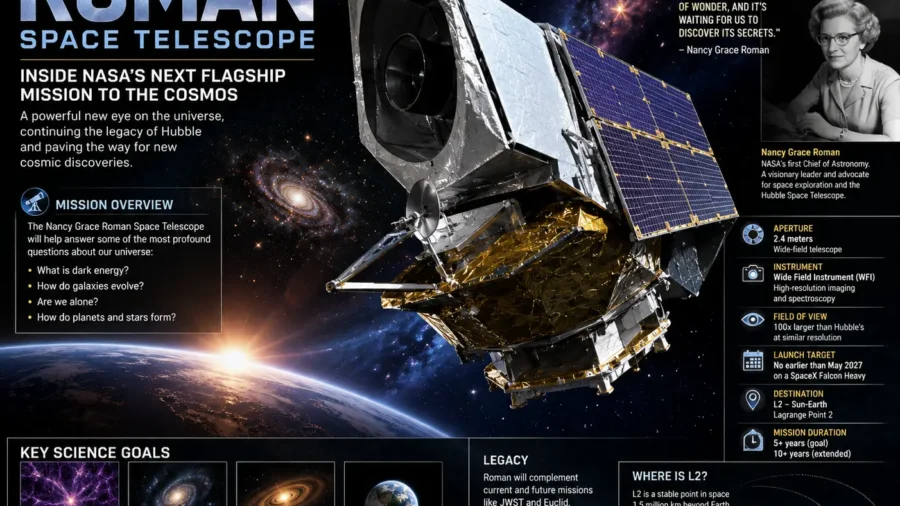
Nancy Grace Roman Space Telescope is the name of NASA’s newest flagship observatory, and it is designed to change the way scientists study the universe. Built with a field of view roughly one hundred times larger than the Hubble Space Telescope, this NASA mission is meant to capture sweeping, high-resolution images of huge patches of sky in a single pass. Where older observatories peer closely at small regions, the Nancy Grace Roman Space Telescope is built to survey the sky broadly and quickly, gathering data on billions of galaxies over its operating life.
NASA has scheduled the Roman Space Telescope to launch aboard a SpaceX Falcon Heavy rocket from Launch Complex 39A at Kennedy Space Center in Florida, targeting liftoff at 7:26 a.m. EDT on August 30, 2026. Notably, this places the mission roughly nine months ahead of its most recent official schedule, a rare achievement for a space telescope project of this scale and cost.
Who Was Nancy Grace Roman?
The Nancy Grace Roman Space Telescope is named after Dr. Nancy Grace Roman, NASA’s first chief astronomer and a pioneering figure often remembered as the “mother of the Hubble Space Telescope.” Roman was instrumental in building the case for placing telescopes above Earth’s atmosphere, laying institutional groundwork that eventually led to Hubble’s launch in 1990. NASA renamed this mission in her honor in 2020, replacing its earlier technical acronym, WFIRST, with a name that reflects her lasting influence on American astronomy.
Mission Goals of the Roman Space Telescope
NASA built this observatory to answer some of astrophysics’ biggest open questions. The core Roman Space Telescope objectives include:
- Investigating the nature of dark energy and the accelerating expansion of the universe
- Studying dark matter through its gravitational effects on cosmic structure
- Conducting a large-scale statistical census of exoplanets throughout the Milky Way
- Directly imaging exoplanets and planet-forming disks using advanced starlight-blocking technology
- Producing enormous infrared sky surveys that complement narrower, deeper observatories like the James Webb Space Telescope
NASA officials have compared the difference between Roman and its predecessors to looking through a keyhole versus opening a door — Hubble and Webb reveal fine detail in narrow slices of sky, while Roman is designed to reveal the broader architecture of the universe.
Key Instruments Aboard the Telescope
Nancy Grace Roman Space Telescope carries two primary science instruments, each built for a distinct purpose.
| Instrument | Function | Notable Capability |
|---|---|---|
| Wide Field Instrument (WFI) | Near-infrared imaging and spectroscopy | 300.8-megapixel camera; field of view about 100 times larger than Hubble’s |
| Coronagraph Instrument (CGI) | High-contrast imaging and spectrometry | Blocks starlight to directly image faint exoplanets and debris disks |
| Primary Mirror | Light collection | 2.4-meter aperture, comparable in size to Hubble’s mirror |
| Orbit | Observing position | Sun-Earth Lagrange Point 2 (L2), about 1 million miles from Earth |
This combination allows the Roman Space Telescope to serve two roles at once: a wide-survey machine capturing enormous volumes of imaging data, and a precision instrument capable of resolving individual planetary systems around nearby stars.
Launch Details and Journey to Space
NASA and SpaceX are targeting the Nancy Grace Roman Space Telescope’s liftoff for 7:26 a.m. EDT on Sunday, August 30, 2026, using a Falcon Heavy rocket. After launch, the observatory is expected to take about a month to reach the Sun-Earth Lagrange Point 2, followed by a multi-month commissioning period during which engineers will test its instruments before science operations begin.
Roman’s history stretches back nearly three decades in concept form, having survived several proposed cancellations and a formal renaming before reaching the launch pad. NASA has described the mission as arriving roughly nine months ahead of its most recent target schedule, following a Flight Readiness Review completed in late August 2026.
How Roman Compares to Hubble and James Webb
A common question is how the Nancy Grace Roman Space Telescope fits alongside NASA’s other major observatories. Rather than replacing Hubble or the James Webb Space Telescope, Roman is designed to complement them.
| Feature | Hubble Space Telescope | James Webb Space Telescope | Nancy Grace Roman Space Telescope |
|---|---|---|---|
| Launch Year | 1990 | 2021 | 2026 |
| Primary Focus | Visible and UV light, deep imaging | Infrared, deep and detailed observations | Wide-field infrared surveys |
| Field of View | Narrow | Narrow | Roughly 100x wider than Hubble |
| Orbit | Low Earth orbit | Sun-Earth L2 | Sun-Earth L2 |
| Mission Strength | High-resolution detail | Deep infrared detail | Speed and scale of sky coverage |
While James Webb Space Telescope excels at deep, detailed observations of specific targets, the Roman Space Telescope is engineered to survey vast areas quickly, making it especially well-suited for statistical studies of exoplanets, dark matter mapping, and dark energy research across billions of galaxies.
Why the Roman Space Telescope Matters for Astronomy
Nancy Grace Roman Space Telescope is expected to detect on the order of 100,000 new exoplanets over its operating lifetime, primarily through a technique called gravitational microlensing. This method allows astronomers to detect planets by observing how their gravity bends and magnifies light from a background star, a technique especially effective for finding smaller, more distant worlds that other methods often miss.
Beyond exoplanets, the mission’s wide-field surveys are expected to help researchers build one of the most detailed maps yet of the universe’s large-scale structure, offering fresh insight into how dark energy has shaped cosmic expansion over billions of years. NASA’s primary mission plan for Roman spans five years, with officials noting the observatory carries enough propellant to potentially operate for a decade or more.
Frequently Asked Questions
What is the Nancy Grace Roman Space Telescope?
It is NASA’s next flagship space observatory, designed for wide-field infrared surveys to study dark energy, dark matter, and exoplanets.
When did the Roman Space Telescope launch?
NASA targeted liftoff for 7:26 a.m. EDT on August 30, 2026, aboard a SpaceX Falcon Heavy rocket from Kennedy Space Center.
Who is Nancy Grace Roman?
She was NASA’s first chief astronomer, honored for her foundational role in establishing space-based astronomy programs, including work that helped pave the way for the Hubble Space Telescope.
How is Roman different from Hubble and James Webb?
The Roman Space Telescope has a much wider field of view than either predecessor, allowing it to survey large areas of sky quickly rather than focusing narrowly on single targets.