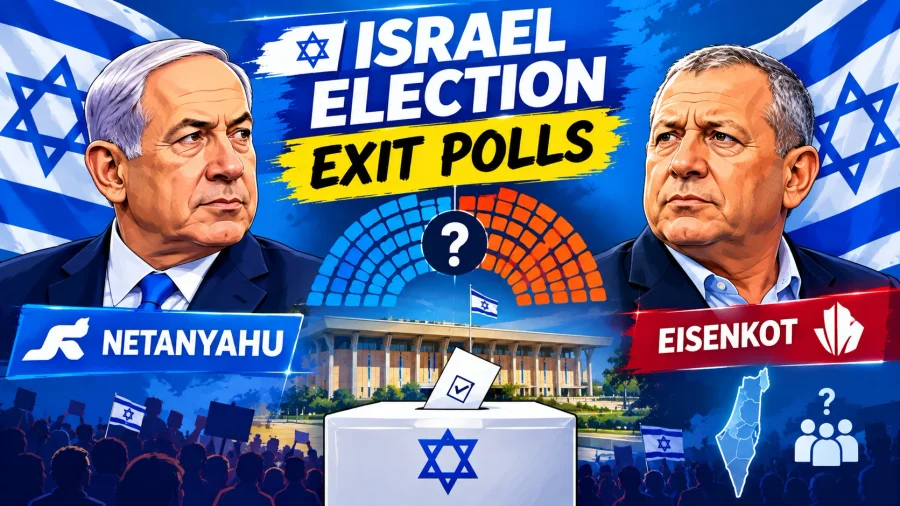

Israeli elections exit polls delivered the one result nobody wanted: no clear winner. On a night of record turnout, the main broadcasters projected that Prime Minister Benjamin Netanyahu’s bloc and former army chief Gadi Eisenkot’s bloc would each land around the low 50s in the 120-seat Knesset, with neither anywhere near the 61 seats needed for a majority. Both men stepped up to claim they would form the next government, and the real count is still coming in.
Israel election results live coverage has been shifting through the night and into Wednesday. As partial counts came in, Netanyahu’s bloc edged ahead of where the exit polls had put it, but it still sat well short of 61, which keeps the question “who won Israel election 2026” open for now. This guide explains the exit polls, the early counted results, the bloc arithmetic, why the channels disagreed and what happens next, with tables so you can follow the numbers.
Israeli Elections Exit Polls: What the Three Main Channels Showed
Israeli elections exit polls from Israel’s three main television channels agreed on the big picture, which was a deadlock, but differed on the details. Channel 12 had Eisenkot’s bloc on 52 seats and Netanyahu’s on 50. Kan 11 initially projected Eisenkot’s bloc on 53 and Netanyahu’s on 50, then revised to a 51-51 tie. Channel 13 gave Likud 25 seats and Eisenkot’s Yashar! 23. Reports from other outlets, such as Axios, summarised the polls as Netanyahu’s bloc on 51 to 52 seats and Eisenkot’s on 49 to 51.
Channel 14, which is strongly pro-Netanyahu, was the outlier, projecting 60 seats for Netanyahu’s coalition and 43 for Eisenkot’s, with Likud on 30. That’s a very different picture, and it’s a reminder to check which broadcaster is behind a poll.
Exit Poll Comparison
| Channel | Netanyahu Bloc | Eisenkot Bloc | Largest Party |
|---|---|---|---|
| Channel 12 | 50 | 52 | Likud 24, Yashar! 22 |
| Kan 11 (first poll) | 50 | 53 | Likud 25, Yashar! 21 |
| Kan 11 (revised) | 51 | 51 | Likud largest |
| Channel 13 | Not stated in reports | Not stated in reports | Likud 25, Yashar! 23 |
| Channel 14 | 60 | 43 | Likud 30 |
| Axios summary of polls | 51 to 52 | 49 to 51 | Likud 27, Yashar! 21 |
Exit polls are estimates based on interviews at polling stations, and they’re revised through the night. Treat them as indications, not results.
Israel Election Results Live: What the Counted Votes Show So Far
Israel election results live trackers began showing counted votes soon after the polls closed at 10:00 PM local time. As the count passed the halfway mark, Likud led as the largest party with about 27 seats and Eisenkot’s Yashar! had about 21 to 22. One tracker at 56.7% of polling sections reported showed Netanyahu’s bloc on about 55 seats and Eisenkot’s bloc on 49, and the Haaretz live blog, with over half the votes counted, put Netanyahu’s bloc at 56. Naftali Bennett’s Together list was on about 11 seats, and the Democrats led by Yair Golan on around 9.
The Arab parties, which sit outside both main blocs, were projected to win roughly 16 to 19 seats combined, a significant number that complicates every coalition calculation. Counts are partial and unofficial until the Central Elections Committee finishes, and the seat numbers can still move.
Partial Count Snapshot (Wednesday Morning, Unofficial)
| List | Leader | Approximate Seats |
|---|---|---|
| Likud | Benjamin Netanyahu | About 27 |
| Yashar! | Gadi Eisenkot | About 21 to 22 |
| Together | Naftali Bennett | About 11 |
| The Democrats | Yair Golan | About 9 |
| Arab parties (combined) | Various | About 16 to 19 |
| Netanyahu’s bloc | Likud, Otzma, Shas, UTJ and allies | About 55 to 56 |
| Eisenkot’s bloc | Yashar! and allies | About 49 |
Figures come from partial counts reported by Haaretz, The Jerusalem Post and live trackers, and they change as more ballots are counted.
Who Won Israel Election 2026? The Honest Answer
Who won Israel election 2026 doesn’t have a clean answer yet, and that’s the story. Likud appears to be the largest single party, which Netanyahu pointed to when he said “Likud is the largest party in Israel”. But being the largest party isn’t the same as having a majority, and Eisenkot’s side declared victory after the exit polls, saying they showed a lack of confidence in Netanyahu and the government in place on October 7.
In Israel, the winner is whoever can build a coalition of 61 seats, not necessarily whoever finishes first. Right now neither bloc has a clear route to that number, which makes the weeks of negotiation after the count as important as the vote itself.
Who Won? Two Ways to Read the Result
| Reading | Who Benefits | Why |
|---|---|---|
| Largest party | Likud | It leads in most exit polls and the partial count |
| Largest bloc after the count | Netanyahu’s bloc, narrowly | Partial results put it ahead of Eisenkot’s |
| Majority of 61 | Neither | Both blocs sit well short |
| Moral or political claim | Both sides | Each declared it would form the next government |
Record Turnout: The Highest in More Than 20 Years
Israel election turnout was the other headline. The Central Elections Committee reported 77.7% turnout when polls closed, the highest since 1999 and about seven points higher than in 2022. Turnout at midday was already the highest recorded at that hour since 1973, and participation among soldiers was also reported as very high.
High turnout can cut either way in a close race, which is part of why the exit polls were so tightly matched. It also means the result carries more weight as a statement by the electorate.
Turnout Facts
| Measure | Figure |
|---|---|
| Final turnout at poll close | 77.7% |
| Comparison | Highest since 1999; about 7 points above 2022 |
| Midday turnout | Highest at that hour since 1973 |
| Expected final results | Could take days |
Netanyahu vs Eisenkot: The Two Leaders in the Spotlight
Netanyahu is Israel’s longest-serving prime minister, with almost two decades in office across multiple terms, and he led a government that was sworn in on December 29, 2022. The Knesset dissolved on July 17, 2026, after months of pressure and political fractures, which triggered this election. Likud held 32 seats before the vote, so the projected figures represent a drop for his party from that starting point.
Gadi Eisenkot is a former chief of staff of the Israel Defense Forces who joined the emergency war cabinet after the October 7 attacks and now leads the Yashar! party. His message in the campaign centred on change from a government he links to the failures of October 7. After the exit polls he said they showed a complete lack of confidence in Netanyahu and that if Netanyahu were a decent leader, he would leave the stage.
The Leaders at a Glance
| Detail | Benjamin Netanyahu | Gadi Eisenkot |
|---|---|---|
| Party | Likud | Yashar! |
| Role before the election | Prime minister | Opposition leader and former IDF chief of staff |
| Pre-election seats | Likud held 32 | Newly formed party |
| Election night message | Likud is the largest party; wants a “strong Jewish right-wing national government” | Result shows lack of confidence in Netanyahu; he’ll form the next coalition |
Why Neither Side Has 61: The Coalition Math
Israel coalition talks start from a simple problem. The Knesset has 120 seats, and 61 are needed. Netanyahu’s bloc, made up of Likud and its religious and nationalist partners such as Otzma, Shas and United Torah Judaism, is in the mid-50s in the partial count. Eisenkot’s bloc, made up of Yashar! and its allies, is around 49 to 52 depending on the poll. That leaves the Arab parties, with roughly 16 to 19 seats, as a block that neither main camp has traditionally relied on for a government.
That’s why analysts say stalemate is the most likely outcome. The ways out are limited: a unity government between Netanyahu and Eisenkot, a smaller party breaking from its bloc, or another election. Netanyahu didn’t mention a unity government in his speech, which instead called for a strong right-wing government.
Paths Out of the Deadlock
| Option | What It Would Require |
|---|---|
| Netanyahu-led right-wing government | A majority of 61 from his bloc, which partial counts don’t show |
| Eisenkot-led coalition | Support beyond his bloc, including Arab parties, which is politically difficult |
| Unity government | Netanyahu and Eisenkot agreeing to sit together, which both have so far avoided |
| Defections | A party or members leaving a bloc to tip the balance |
| New election | If no coalition can be formed within the legal deadlines |
What Happens Next After the Israeli Election
Knesset election 2026 results will be finalised by the Central Elections Committee over the coming days. After that, the president consults the parties and gives one candidate the task of forming a government. Under Israeli law as it is generally described, that candidate has 28 days, with a possible extension, to put together a coalition, and if they fail the president can turn to another candidate. If no one succeeds, the country can head to another election.
Timeline Ahead
| Step | What to Watch |
|---|---|
| Next few days | Final counts, seat allocation and official results |
| After the results | President’s consultations with party leaders |
| Following that | A candidate is tasked with forming a coalition |
| Coalition window | About 28 days, with a possible extension |
| If it fails | Another candidate, or a new election |
Frequently Asked Questions About the Israeli Elections Exit Polls
1. Who won the Israel election in 2026?
There is no clear winner yet. Exit polls and partial counts show Likud as the largest party, but neither Netanyahu’s bloc nor Eisenkot’s bloc has the 61 seats needed for a majority.
2. What did the Israeli election exit polls show?
They projected a deadlock. Channel 12 had Netanyahu’s bloc on 50 seats and Eisenkot’s on 52, Kan 11 later showed a 51-51 tie, and pro-Netanyahu Channel 14 projected 60 seats for his coalition.
3. Where can I follow Israel election results live?
The Central Elections Committee publishes official counts, and news outlets and live trackers update them through the night. Check timestamps, because the figures are partial and change as more votes are counted.
4. How many seats are in the Knesset, and how many are needed to govern?
The Knesset has 120 seats, and a coalition needs at least 61 to form a majority.
5. What was the turnout in the 2026 Israeli election?
The Central Elections Committee reported 77.7% when polls closed, the highest since 1999.
6. Who is Gadi Eisenkot?
He is a former chief of staff of the Israel Defense Forces who led the opposition and the Yashar! party. He joined the war cabinet after the October 7 attacks.
7. Which party is the largest in the Knesset election?
Likud led in most exit polls and in the partial count, with figures ranging from about 24 to 30 seats depending on the channel and the stage of the count.
8. Why did the exit polls differ?
Each channel uses its own sample and method, and Channel 14 is openly pro-Netanyahu, so its numbers differ sharply. Exit polls are also revised through the night.
9. What role do the Arab parties play?
Together they are projected to win about 16 to 19 seats, which is large enough to complicate coalition math, though they’re not part of either main bloc.
10. What happens if neither side can form a government?
The president can ask another candidate to try, a unity government could be negotiated, or the country could go to a new election.
11. When will the final results be announced?
The Central Elections Committee will finalise them over the coming days, so seats could still change.
12. Did Netanyahu or Eisenkot concede?
No. Both claimed they would form the next coalition, and neither conceded in the reports available at the time of writing.