
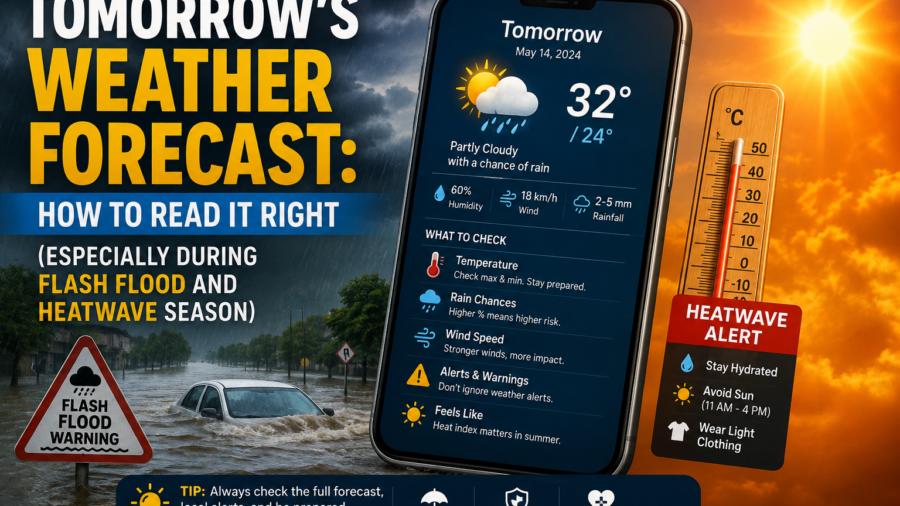
Why “Tomorrow’s Weather” Searches Spike Every Evening
If you’ve ever searched “today’s evening weather” or “tomorrow’s weather,” you’re part of a huge, predictable pattern. Most people check forecasts at two points in the day: first thing in the morning, to decide what to wear, and again in the evening, to plan the next day. During monsoon and heatwave transitions, that evening check becomes more urgent — people want to know not just the temperature, but whether rain, thunderstorms, or extreme heat are on the way.
A few things make evening forecast-checking especially useful:
- Short-range accuracy is higher. A forecast for tomorrow is far more reliable than one for ten days out, because the atmospheric models have less time to drift from reality.
- Local nuance matters. A forecast for “Uttar Pradesh” as a whole can hide big differences between, say, Lucknow and a district three hours away. Always narrow your search to your city or district when you can.
- Evening data reflects the latest satellite and radar updates, which is why the same query typed in the morning and again at night can return different results.
Understanding the Day-After-Tomorrow (“Parso”) Forecast
Search interest in the day-after-tomorrow forecast tends to follow the same evening pattern, but it comes with a caveat: two-day-out forecasts are noticeably less precise than next-day forecasts. Treat them as a general trend indicator — useful for deciding whether to reschedule a trip or an outdoor event — rather than an exact prediction of rainfall or temperature.
The Rise of “Sudden Flash Flood Risk” Searches
Among all the queries tracked recently, one stands out for its sharp jump: searches related to the risk of sudden flash floods. Unlike routine weather checks, this kind of search usually spikes for a reason — heavy overnight rain, a river or drain overflowing nearby, or an official alert circulating on local news or social media.
If you’re searching this term because you’re genuinely worried about flooding in your area, here’s what actually helps in the moment:
- Check official sources first. The India Meteorological Department (IMD) and your state disaster management authority issue flash flood warnings that are far more reliable than general search results.
- Look at rainfall accumulation, not just today’s forecast. Flash floods are often caused by rain that fell over the previous 24–48 hours, not by what’s forecast for right now.
- Know your local flood-prone points. Low-lying roads, underpasses, and areas near drains or small rivers are the first to flood, even during moderate rain.
- Avoid crossing moving water, whether on foot or in a vehicle — this is the single biggest cause of flood-related injuries and deaths.
- Keep your phone charged and location services on during active warnings, so you can receive alerts and share your location if needed.
Extreme Heat: Why “Bahut Zyada Garmi” Searches Still Matter
Even as flood-related searches rise, “extreme heat” continues to be a heavily searched term — a reminder that many parts of India swing between heatwave conditions and sudden heavy rainfall within the same season. A few practical points worth remembering during extreme heat spells:
- Peak heat risk is usually between 12 PM and 4 PM; plan outdoor work outside this window when possible.
- Hydration matters more than shade alone — carry water even on short trips.
- Watch for signs of heat exhaustion (dizziness, heavy sweating, nausea) in yourself and others, especially outdoor workers, elderly family members, and children.
Should You Trust AccuWeather, IMD, or a Search Result?
Searches comparing “tomorrow’s weather” with specific sources like AccuWeather are common, and for good reason — different platforms pull from different models and update at different intervals. As a rule of thumb:
- For official warnings (flash floods, cyclones, heatwave alerts): go to IMD or your state disaster management department.
- For day-to-day planning: app-based forecasts like AccuWeather are convenient and generally reliable for short-range predictions.
- For hyperlocal detail (a specific neighborhood or village): cross-check two sources if the decision matters — for example, before a long commute or an outdoor event.
Checking the Next 10 Days: What’s Realistic
Ten-day forecasts are useful for spotting broad patterns — an approaching heat spell, a stretch of monsoon rain — but the day-by-day details in the back half of that window shift often. Use extended forecasts to plan loosely (should I schedule the trip this week or next?) and switch to next-day or same-day forecasts for anything time-sensitive.
Q1. How accurate is a “tomorrow’s weather” forecast compared to a 10-day forecast? Next-day forecasts are generally the most reliable, since they’re based on the most current data. Accuracy drops noticeably after about three to five days, and by day ten, forecasts should be treated as a general trend rather than a precise prediction.
Q2. Why do flash flood search terms spike so suddenly? Flash flood searches usually spike in response to a real, immediate trigger — heavy rain that has already fallen, a local alert, or visible flooding nearby. Because flash floods can develop within hours, this kind of search often reflects urgent, real-time concern rather than routine planning.
Q3. Is it better to check the weather in the morning or the evening? Both matter, but for different reasons. Morning checks help you plan your immediate day; evening checks — the most common time people search “tomorrow’s weather” — reflect the most updated forecast for the following day.
Q4. What should I do if I see a flash flood warning for my area? Move away from low-lying areas and avoid crossing flooded roads or drains, even if the water looks shallow. Follow updates from IMD or your local disaster management authority, and avoid relying solely on search results during an active warning.
Q5. Why does the weather forecast for a whole state, like Uttar Pradesh, feel inaccurate for my city? State-level forecasts average conditions across a large area. For anything time-sensitive, search for your specific city or district rather than the state as a whole — the difference in rainfall and temperature between locations even within the same state can be significant.
Q6. Is it worth checking multiple weather sources, like both AccuWeather and IMD? For everyday planning, one reliable source is usually enough. For decisions where safety is involved — flooding, extreme heat, or travel during storms — cross-checking an app-based forecast against official IMD alerts is worth the extra minute.
Related Articles / Further Reading
- Manchester United vs Leeds: 5 Explosive Rivalry Facts
- Arsenal vs Dortmund Final Score: Karetsas Stunner Fires Dortmund to Emirates Cup Win
- Man City vs Atlético Madrid Today Match Result: Marmoush Brace Powers Comeback Win in Seoul
- Jorge Messi Death: Lionel Messi’s Father Dies at 68
- Awarapan 2: Release Date, Cast, Trailer, Music Director
Weather can change quickly, especially during transition seasons between heat and monsoon rain. Whichever source you check, treat official flash flood and heatwave warnings as the final word over any general search result.