
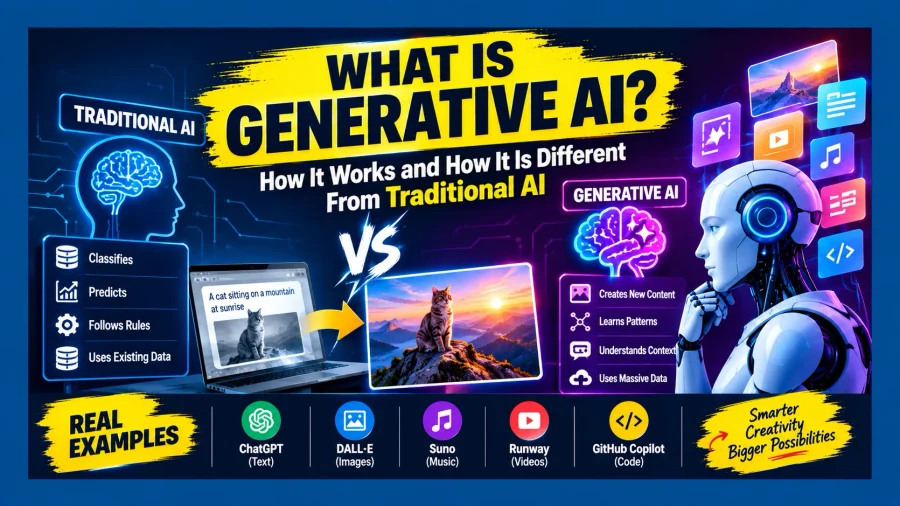

What is Generative AI has become one of the most searched technology questions of the past few years, and for good reason — tools like ChatGPT, Midjourney, and countless AI image and writing generators have moved this concept from research labs straight into everyday conversation. At its core, Generative AI refers to artificial intelligence systems capable of creating entirely new content — text, images, audio, video, or code — rather than simply analysing or classifying existing data.
Generative AI examples are now genuinely everywhere in daily digital life, from chatbots that draft emails to tools that generate realistic images from a simple text description. Understanding exactly how this technology works, how it’s trained, and how it fundamentally differs from older, more traditional forms of AI is worth taking the time to properly understand, especially given how quickly this space continues to evolve.
What Is Generative AI in Simple Words
What is Generative AI in simple words comes down to this: it’s a type of artificial intelligence that learns patterns from massive amounts of existing data, and then uses those learned patterns to produce brand-new content that didn’t exist before. Instead of just answering “yes” or “no,” sorting information into categories, or predicting a single number, Generative AI can write a poem, compose an image, draft a piece of code, or even generate a synthetic voice recording — content that is genuinely original, even though it’s built entirely from patterns learned during training.
Think of it this way: if traditional software follows a fixed set of rules to produce a predictable outcome, Generative AI instead learns the underlying structure and style of its training data well enough to produce something new that follows those same patterns, without ever being explicitly told what the final output should look like.
Generative AI Examples: Tools You’ve Probably Already Used
Generative AI examples span a wide range of formats and use cases, and chances are you’ve interacted with at least one of these without necessarily thinking of it in these terms. Large language models like ChatGPT and Claude generate human-like text responses to questions and prompts. Image generation tools like Midjourney and DALL-E create original visuals from written descriptions. Code-generation assistants help developers write and debug software, while voice synthesis tools can generate remarkably natural-sounding speech from text input.
Common Generative AI Tools by Category
| Category | Example Tools | What They Generate |
|---|---|---|
| Text Generation | ChatGPT, Claude, Gemini | Written responses, essays, code, summaries |
| Image Generation | Midjourney, DALL-E, Stable Diffusion | Original images from text prompts |
| Audio/Voice | ElevenLabs, murf.ai | Synthetic speech, voice cloning |
| Video Generation | Runway, Sora | Short video clips from text or images |
| Code Generation | GitHub Copilot, Claude Code | Software code and programming assistance |
What Is Generative AI IBM: How a Major Tech Player Defines It
What is Generative AI IBM and other major technology companies describe centres on the same core idea, generally framed around the model’s ability to learn patterns and structures from training data and then generate new, original content based on that learned understanding. Large technology providers typically emphasise that Generative AI models are built on deep learning architectures, particularly a type of neural network design called transformers, which allow the model to understand context and relationships across large sequences of data — whether that’s words in a sentence or pixels in an image.
Major tech companies also tend to stress that these models don’t simply retrieve or copy existing content; instead, they generate statistically probable new combinations based on everything they learned during training, which is precisely why outputs can feel creative and original rather than repetitive or templated.
How Does Generative AI Work: The Basics Explained Simply
How does Generative AI work in a genuinely simple sense starts with a massive training process. The model is fed enormous volumes of existing data — text from books, articles, and websites for language models, or images paired with descriptions for image-generation tools. During this training phase, the model learns statistical patterns: which words tend to follow other words, which visual elements tend to appear together, and how different pieces of content are typically structured.
Once training is complete, the model can take a new prompt or input and generate original content by predicting, step by step, what should logically come next based on everything it learned — essentially making highly educated, pattern-based predictions about what a coherent, relevant piece of content should look like.
How Generative AI Works: The Process, Step by Step
| Stage | What Happens |
|---|---|
| Data Collection | Massive datasets of text, images, or audio are gathered |
| Training | The model learns statistical patterns and relationships within the data |
| Fine-Tuning | The model is refined for specific tasks or improved accuracy |
| Inference | The trained model generates new content based on a user’s prompt |
| Output | The model produces original text, image, audio, or code |
AI Chatbots: A Common Generative AI Application
Generative AI is being used in a growing range of applications, including content creation, coding and conversational tools. AI chatbots can use generative AI models to understand prompts and create natural-language responses for users. For a closer look at how conversational AI systems work, read our guide on what an AI chatbot is and how it works.
What Can Generative AI Do After Completing Its Training Phase
What can Generative AI do after completing its training phase is where the technology actually becomes useful to end users. Once training wraps up, the model enters what’s called the inference stage — this is when it takes a user’s prompt and generates a fresh, original response in real time, without needing to be retrained for every single new request.
At this stage, a well-trained model can write essays, answer questions, generate images from descriptions, translate languages, summarise long documents, write functional code, and even hold extended, context-aware conversations — all without any further training, simply by applying the patterns it already learned during the training phase to each new input it receives.
How Is Generative AI Trained: A Closer Look at the Process
How is Generative AI trained typically involves several distinct phases, each building on the last. The process usually begins with pre-training, where the model is exposed to a massive, broad dataset to learn general language or visual patterns. This is followed by fine-tuning, where the model is trained further on a narrower, more specific dataset to improve performance on particular tasks.
Many modern systems also go through a stage called reinforcement learning from human feedback, where human reviewers rate the quality of the model’s outputs, and the model is adjusted to produce responses more closely aligned with what people actually find helpful, accurate, and appropriate. This human-feedback stage has become an increasingly important part of training the more advanced Generative AI systems available today.
How Does Image Generative AI Work: A Slightly Different Process
How does image generative AI work differs somewhat from text-based models, though the underlying principle of learning patterns from data remains the same. Most modern image generators use a technique called diffusion, where the model learns to gradually remove random noise from an image over many small steps, eventually arriving at a coherent picture that matches a given text description.
During training, the model is shown millions of image-and-caption pairs, gradually learning the relationship between specific words and visual concepts — what a “sunset over mountains” typically looks like, for instance, or how a specific art style tends to be rendered. When generating a new image, the model starts from random visual noise and progressively refines it, step by step, into a final image that matches the text prompt it was given.
How Generative AI Fits Into Artificial Intelligence
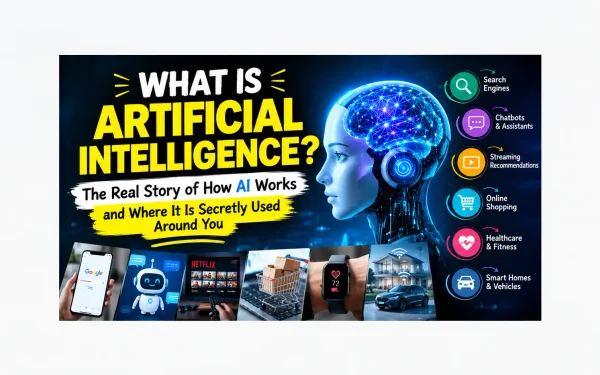
Generative AI is part of the broader field of artificial intelligence and focuses on creating new content based on patterns learned from data. Understanding the basics of AI can make it easier to see how generative AI differs from other AI technologies and applications. For a broader explanation of the technology, its working process and real-world uses, read our guide on what artificial intelligence is, how AI works and where it is used.
How Does Generative AI Harm the Environment: An Honest Look
How does Generative AI harm the environment is a genuinely important question that’s often overlooked amid the excitement around this technology’s capabilities. Training large Generative AI models requires substantial computing power, typically running on massive clusters of specialised hardware over extended periods, which consumes significant amounts of electricity. Depending on the energy source powering the data centre involved, this can translate into a meaningful carbon footprint.
Beyond the initial training phase, ongoing usage also carries an environmental cost — every time a user submits a prompt and receives a generated response, that request draws on computing resources and electricity at a data centre somewhere. As Generative AI tools scale to serve millions of users daily, the cumulative energy and water usage (many data centres use water for cooling) has become a genuine area of scrutiny and ongoing research into more energy-efficient model designs.
How Is Generative AI Related to Artificial Intelligence?
Generative AI is a branch of artificial intelligence that focuses on creating new content such as text, images, audio, video and code. To understand where generative AI fits into the broader field, read our detailed guide on artificial intelligence and how AI works.
Generative AI Vs AI: Understanding the Broader Relationship
Generative AI vs AI is a comparison that trips up a lot of people, mainly because Generative AI isn’t a separate, competing technology — it’s actually a specific subset within the much broader field of artificial intelligence. AI as a whole encompasses any system designed to perform tasks that typically require human intelligence, including recognising images, understanding speech, making predictions, and yes, generating new content.
Generative AI specifically refers to the branch of AI focused on creation rather than classification or prediction. So rather than being rivals, Generative AI is best understood as one particular application of the broader AI field, sitting alongside other AI subfields like traditional predictive AI, robotics, and computer vision.
Generative AI Vs Traditional AI: The Core Difference
Generative AI vs traditional AI comes down fundamentally to output type. Traditional AI systems, often called discriminative or analytical AI, are designed to analyse existing data and produce a specific, defined output — classifying an email as spam or not spam, predicting whether a loan applicant is likely to default, or recognising a face in a photo. These systems work within a fixed set of possible outputs determined in advance.
Generative AI, by contrast, produces open-ended, original output that didn’t exist in that exact form before. There’s no fixed, predetermined answer it’s selecting from — instead, it’s constructing something new based on learned patterns, which is precisely why its output can vary meaningfully even when given the same prompt more than once.
Difference Between Generative AI and Traditional AI
| Aspect | Traditional AI | Generative AI |
|---|---|---|
| Primary Function | Classify, predict, or analyse | Create new content |
| Output Type | Fixed, predetermined categories or values | Open-ended, original content |
| Example Task | Spam detection, fraud prediction | Writing text, generating images |
| Output Consistency | Same input generally gives same output | Same prompt can generate varied outputs |
| Underlying Goal | Accuracy on a defined task | Creativity and coherence in new content |
Traditional AI Examples: What This Older Category Actually Looks Like
Traditional AI examples are honestly everywhere in daily life, even though they attract far less attention than Generative AI tools do. Spam filters that sort emails, recommendation engines that suggest products or shows based on your past behaviour, fraud detection systems used by banks, facial recognition used for phone unlocking, and predictive text on your keyboard are all examples of traditional, discriminative AI systems doing focused, narrow tasks extremely well.
These systems have been quietly powering much of the digital experience for years, often working so reliably in the background that most people don’t even register them as “AI” in the same way they now think of ChatGPT or similar generative tools.
Is Traditional AI Better Than Generative AI: It Depends on the Task
Is traditional AI better than Generative AI is genuinely the wrong framing for this question, since the two are built for fundamentally different purposes. For narrow, well-defined tasks with a clear correct answer — like detecting fraudulent transactions or predicting equipment failure — traditional AI generally remains more accurate, efficient, and easier to interpret than a generative model would be for the same task.
For tasks involving creation, brainstorming, or open-ended problem-solving — drafting content, generating design concepts, or exploring creative variations — Generative AI is clearly the better-suited tool. Rather than one being universally “better,” the right choice comes down entirely to whether the task calls for classification and prediction, or genuine creation of something new.
Generative AI Vs Agentic AI: A Newer, Important Distinction
Generative AI vs agentic AI is one of the more recent distinctions gaining attention as the field continues to evolve. Generative AI, as covered throughout this article, focuses on creating content in response to a prompt — it generates an output and essentially stops there, waiting for the next instruction. Agentic AI, by contrast, refers to systems designed to autonomously plan and carry out multi-step tasks toward a goal, often making decisions, using external tools, and adjusting its approach along the way without needing a new prompt for every single step.
In practice, agentic AI systems are frequently built on top of generative models — using a generative AI’s language understanding and content-creation abilities as one component within a larger, more autonomous system capable of independently pursuing a broader objective across multiple steps.
Generative AI vs Agentic AI: Key Differences
| Aspect | Generative AI | Agentic AI |
|---|---|---|
| Core Function | Generates content based on a prompt | Plans and executes multi-step tasks autonomously |
| Interaction Style | Responds to one prompt at a time | Can act independently across multiple steps |
| Example | Writing an essay when asked | Researching, drafting, and scheduling a task without repeated prompts |
| Relationship | Often the foundation agentic systems are built on | Frequently uses generative AI as one component |
Generative AI Vs Predictive AI: Creation vs Forecasting
Generative AI vs predictive AI highlights another important distinction within the broader AI landscape. Predictive AI is specifically designed to forecast future outcomes based on historical data — estimating next quarter’s sales, predicting customer churn, or forecasting weather patterns. Its entire purpose is producing a reliable, data-grounded estimate about something that hasn’t happened yet.
Generative AI, again, is focused on creating new content rather than forecasting outcomes. While both fields rely on learning patterns from historical data, predictive AI applies those patterns to estimate future numbers or events, whereas Generative AI applies them to construct entirely new pieces of content, text, or media.
What Is the Difference Between AI and Generative AI and Agentic AI
What is the difference between AI and Generative AI and Agentic AI is best understood as a set of nested, overlapping categories rather than three completely separate technologies. AI is the broadest umbrella term, covering any system designed to perform tasks requiring human-like intelligence. Generative AI sits within that broader field as a specific subset focused on content creation. Agentic AI is a further, more recent development, often building on generative capabilities to enable autonomous, multi-step task execution.
AI, Generative AI, and Agentic AI: How They Relate
| Category | Scope | Relationship to the Others |
|---|---|---|
| AI (Broad Field) | Any system mimicking human-like intelligence | Umbrella category covering all AI types |
| Generative AI | Creates new content from learned patterns | A subset of AI |
| Agentic AI | Autonomously plans and executes multi-step tasks | Often built using generative AI as a core component |
What Is Generative AI Course and PPT: Learning the Basics
What is generative AI course options have grown substantially as demand for structured learning in this field has increased, with many universities, online learning platforms, and technology companies now offering dedicated introductory courses covering the fundamentals — neural networks, transformers, prompt engineering, and practical applications. For those preparing presentations, a generative AI PPT covering definitions, real-world examples, the training process, and comparisons with traditional AI tends to be one of the most commonly requested formats for classroom or workplace introductions to this topic, given how visual, example-driven explanations tend to make the concept easier to grasp for a general audience.
Frequently Asked Questions About Generative AI
1. What is Generative AI in simple terms?
Generative AI is a type of artificial intelligence that learns patterns from existing data and uses them to create new, original content like text, images, audio, or code.
2. What are some common examples of Generative AI?
Common examples include ChatGPT and Claude for text, Midjourney and DALL-E for images, and GitHub Copilot for code generation.
3. How does Generative AI differ from traditional AI?
Traditional AI classifies or predicts based on fixed categories, while Generative AI creates open-ended, original content that didn’t exist before in that exact form.
4. How is Generative AI trained?
It’s typically trained through pre-training on large datasets, followed by fine-tuning and often reinforcement learning from human feedback to improve output quality.
5. Does Generative AI have an environmental impact?
Yes, training and running large Generative AI models requires significant computing power and electricity, contributing to a measurable environmental footprint.
6. What is the difference between Generative AI and Agentic AI?
Generative AI creates content in response to a single prompt, while Agentic AI autonomously plans and executes multi-step tasks, often using generative capabilities as one component.
7. Is traditional AI better than Generative AI?
Neither is universally better; traditional AI excels at narrow classification and prediction tasks, while Generative AI is better suited for creative, open-ended content generation.
8. What is the difference between Generative AI and Predictive AI?
Predictive AI forecasts future outcomes based on historical data, while Generative AI creates new content based on learned patterns.
9. What can Generative AI do after its training phase is complete?
Once trained, it can generate text, images, code, and other content in real time based on user prompts, without needing further retraining for each request.
10. How does image-generating AI actually work?
Most image generators use a diffusion process, gradually refining random visual noise into a coherent image that matches a given text description, based on patterns learned from millions of image-caption pairs.


3 Comments