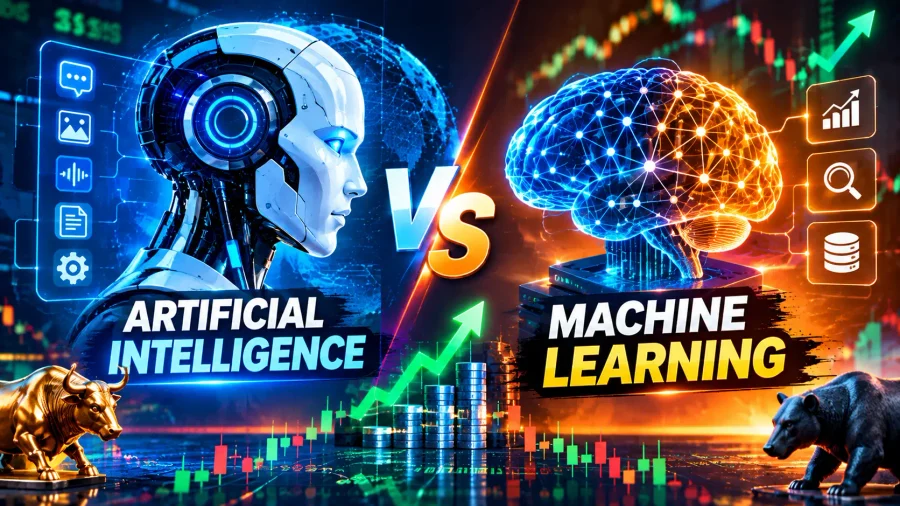

Artificial Intelligence vs Machine Learning is a comparison that shows up in job ads, product launches, college brochures and office arguments, and most of the time the two terms are swapped around as if they meant the same thing. They don’t. One is the destination and the other is one of the roads that leads there. Once that clicks, a surprising amount of the confusion around this whole field simply disappears.
AI vs ML matters far more than it might sound at first. If you’re choosing what to study, what to put on a resume, or which tool to trust at work, knowing the difference stops you from being impressed by buzzwords and helps you ask better questions. This guide goes deeper than the usual two-paragraph explainer. It covers where the terms came from, how each idea actually works under the hood, where deep learning and generative AI fit, and straight answers to the questions people search for most, including the salary one.
Artificial intelligence is a broad field of technology that enables machines to perform tasks that normally require human intelligence, while machine learning is one of the approaches used to build intelligent systems. To understand the broader concept, read our guide on what is artificial intelligence , how AI works and where it is used.
Artificial Intelligence vs Machine Learning: The Core Difference
Artificial Intelligence vs Machine Learning comes down to scope. Artificial intelligence is the big goal: building machines that can do things we’d normally expect to need human intelligence, such as understanding language, recognising patterns, making decisions, planning or solving problems. Machine learning is one specific way of getting there, where a system learns from examples instead of following rules that a programmer typed out by hand.
A helpful way to hold this in your head is a simple nesting. Every machine learning system is a kind of AI, but plenty of AI systems have never learned anything from data. An old chess program that simply follows a long list of hand-written rules and searches through possible moves is AI. It just isn’t machine learning, because nothing about it improves by studying data.
The two terms also arrived at different times. The phrase “artificial intelligence” was introduced in 1956, when a group of researchers gathered for a summer workshop at Dartmouth College and set out to explore whether machines could be made to simulate aspects of intelligence. The phrase “machine learning” came a few years later, in 1959, from Arthur Samuel, who built a checkers program at IBM that got better the more games it played. That history is the whole story in miniature: AI was the ambition, and machine learning was the practical technique that eventually made the ambition work.
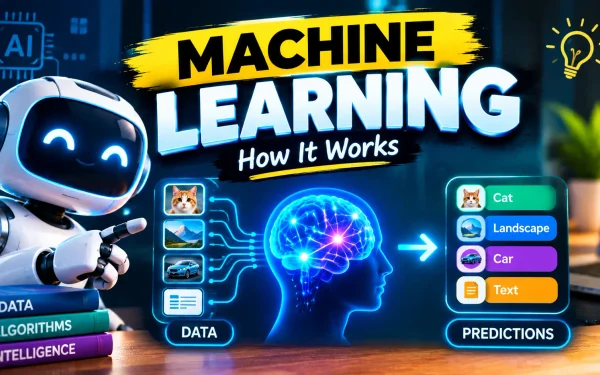
Machine learning allows computer systems to identify patterns in data and use those patterns to make predictions or improve performance without being explicitly programmed for every situation. If you want to explore this concept in more detail, read our guide on what is machine learning and how it works.
AI vs ML: Side-by-Side Comparison
| Aspect | Artificial Intelligence (AI) | Machine Learning (ML) |
|---|---|---|
| What it is | The broad goal of machines acting intelligently | A method where systems learn patterns from data |
| Scope | Wide umbrella covering many techniques | A subset of AI |
| How it works | Can use fixed rules, logic, search or learning | Always learns from data |
| Needs data? | Not always | Yes, usually in large amounts |
| Term first used | 1956 (Dartmouth workshop) | 1959 (Arthur Samuel) |
| Everyday example | A rule-based customer service phone menu | A spam filter that improves as it sees more email |
Types of AI: Narrow, General and Beyond
Artificial Intelligence vs Machine Learning discussions often skip a layer that makes the whole picture clearer: AI itself comes in different strengths. Narrow AI, sometimes called weak AI, is built to do one job or a small group of related jobs well. Every AI system you’ve actually used falls into this category, from a translation app to a recommendation feed to a chatbot. It can look impressive inside its lane and be completely useless outside it.
Artificial general intelligence, usually shortened to AGI, describes a hypothetical system that could learn and perform almost any intellectual task a human can, moving flexibly between very different problems. Researchers disagree sharply about how close that is, or whether current approaches will ever lead there. Beyond that sits the idea of superintelligence, a system far more capable than any human, which remains firmly in the realm of speculation.
It’s worth keeping this ladder in mind whenever a headline claims “AI can now do everything”. What exists today is a collection of very capable narrow systems, and almost all of them are built using machine learning.
Three Levels of AI
| Level | Description | Does It Exist Today? |
|---|---|---|
| Narrow AI | Excels at specific tasks | Yes, every real-world AI tool |
| General AI (AGI) | Human-level flexibility across tasks | No, still theoretical |
| Superintelligence | Far beyond human capability | No, speculative |
How Machine Learning Actually Works
Machine learning follows a surprisingly consistent recipe once you strip away the jargon. You start with data, you pick a model that can learn from that data, you let it practise, and then you test how well it learned. Each step matters, and mistakes in any of them show up as a model that looks smart in the lab and fails in the real world.
It begins with data collection. A spam filter needs thousands or millions of emails already labelled as spam or not spam. A house price model needs records of past sales along with details like size and location. The model then goes through training, where it makes predictions, compares them with the correct answers, measures how wrong it was, and adjusts its internal settings slightly to be less wrong next time. Repeated enough times, those small corrections add up to genuine skill.
After training comes evaluation, where the model is tested on data it has never seen. This step is critical because of a classic trap called overfitting, where a model memorises its training examples instead of learning the underlying pattern. An overfit model scores brilliantly on familiar data and badly on anything new. Finally, once a model passes testing, it is deployed to make predictions on real inputs, a stage often called inference.
The Machine Learning Workflow
| Stage | What Happens | Why It Matters |
|---|---|---|
| Data collection | Gather and clean examples | Poor data leads to poor results |
| Training | Model adjusts itself to reduce errors | This is where learning happens |
| Evaluation | Test on unseen data | Catches overfitting |
| Deployment | Model makes live predictions | Where real value is created |
| Monitoring | Track performance over time | Real-world data changes |
The Three Main Types of Machine Learning
Machine learning is usually divided into three families, and knowing them helps you understand why different tools behave so differently. In supervised learning, the model learns from examples that come with the right answers attached, such as photos labelled “cat” or “dog”. It’s the most common approach and powers things like fraud detection and price prediction.
In unsupervised learning, the model gets data with no labels and has to find structure on its own, for example grouping customers into segments based on behaviour. In reinforcement learning, a system learns by trial and error, earning rewards for good actions and penalties for bad ones. This is the approach behind game-playing systems and some robotics research.
Types of Machine Learning at a Glance
| Type | Learns From | Typical Use |
|---|---|---|
| Supervised | Labelled examples | Spam detection, price prediction |
| Unsupervised | Unlabelled data | Customer segmentation, anomaly detection |
| Reinforcement | Rewards and penalties | Games, robotics, optimisation |
Artificial Intelligence vs Machine Learning vs Deep Learning: How the Three Fit Together
Artificial Intelligence vs Machine Learning vs Deep Learning is easiest to picture as three circles, one inside the other. AI is the largest circle. Machine learning sits inside it. Deep learning sits inside machine learning, and it’s the part behind most of the headline-grabbing results of the past decade.
Deep learning uses neural networks built from many layers of connected units, loosely inspired by how neurons link up in the brain. Each layer picks up patterns in the output of the layer before it. In an image model, early layers might detect edges, middle layers might combine edges into shapes, and later layers might recognise whole objects. The huge advantage is that the system works out useful features on its own instead of relying on a human to define them in advance.
Deep learning’s breakthrough moment is often traced to 2012, when a deep neural network won a major image recognition competition by a wide margin, convincing much of the field to shift direction. A few years later, in 2017, researchers introduced the transformer architecture, which became the foundation for modern language models. The cost of all this power is real, though. Deep learning usually demands enormous datasets and a lot of computing hardware, which is why simpler machine learning methods are still the better choice for many everyday business problems.
AI, ML and Deep Learning: The Three Layers
| Layer | Role | Typical Strength | Example |
|---|---|---|---|
| Artificial Intelligence | The overall goal | Wide range of intelligent behaviour | Voice assistants, game-playing programs |
| Machine Learning | Learning patterns from data | Prediction and classification | Fraud detection, recommendations |
| Deep Learning | Learning with multi-layer neural networks | Images, speech, language | Face unlock, speech-to-text |
Where Generative AI Fits In
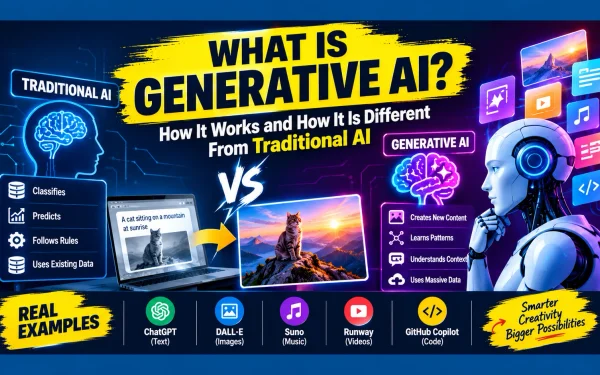
Generative AI is the newest and most talked-about branch, and it lives inside deep learning. Instead of only sorting or predicting, these models create new text, images, audio, video and code based on patterns absorbed during training. If you’ve asked a chatbot to draft an email or asked an image tool for a picture of a dog in a spacesuit, you’ve used it.
Seeing generative AI as part of the same family tree explains why people keep arguing about names. It is AI, it is machine learning and it is deep learning, all at the same time. The label you pick simply depends on how precise you want to be. Calling a chatbot “AI” is fine in conversation, while “a deep learning language model” is the accurate technical description.
Rule-Based AI vs Machine Learning: A Spam Filter Example
Rule-based AI and machine learning solve the same problem in opposite ways, and the cleanest way to see it is with a spam filter. A rule-based version might say: if the email contains the phrase “you have won” and comes from an unknown sender, send it to spam. That works until spammers change their wording, at which point a person has to write new rules, forever.
A machine learning version is shown a huge collection of emails labelled spam or not spam and works out for itself which patterns matter, including combinations of words, senders, links and timing that no human would think to write down. When spammers change tactics, the model can be retrained on fresh examples. This ability to adapt without a programmer rewriting the logic is exactly why machine learning took over so many areas of AI.
Rule-Based Systems vs Machine Learning
| Factor | Rule-Based AI | Machine Learning |
|---|---|---|
| How decisions are made | Hand-written rules | Patterns learned from data |
| Handling change | Needs manual updates | Retrains on new data |
| Transparency | Easy to explain | Can be hard to interpret |
| Best for | Clear, stable logic | Messy, complex patterns |
Is ChatGPT AI or ML?
Is ChatGPT AI or ML has an easy answer: both. ChatGPT is a chatbot built on a large language model, which is a deep learning system, which is a form of machine learning, which is a branch of artificial intelligence. Calling it AI is correct and calling it ML is also correct. The more specific and more useful description is generative AI built on deep learning.
The same logic applies to most tools in the news right now. When a company says its product “uses AI”, it’s worth asking what kind. Often the honest answer is a machine learning model doing one narrow job well, such as ranking search results or flagging unusual payments. That isn’t a criticism, but it’s a good reminder that “AI” on a product page is a marketing word, while “machine learning model” describes something you can actually evaluate.
Modern AI chatbots use technologies such as machine learning and natural language processing to interpret questions and generate relevant responses. However, the exact technologies vary between systems. Learn more about how AI chatbots work in our dedicated guide.
Who Earns More, AI or ML Engineer?
Who earns more, AI or ML engineer is a question without a single clean answer, and anyone quoting a precise gap between the two is probably guessing. The titles overlap heavily. In many companies an “AI engineer” and a “machine learning engineer” do very similar work, and the label depends on the employer’s habits more than on any strict definition.
What really moves pay is everything around the title: years of experience, country and city, company size and type, and how specialised your skills are. Roles that involve building and deploying large models at scale, or research-heavy work, tend to sit at the higher end under either name. For real numbers, check current salary data for your own location rather than trusting a single headline figure that may be years out of date.
AI Engineer vs ML Engineer: What Usually Differs
| Factor | AI Engineer | ML Engineer |
|---|---|---|
| Typical focus | Building complete AI-powered products and systems | Building, training and deploying models |
| Overlap | Very high with ML roles | Very high with AI roles |
| Pay driven mainly by | Experience, location, company, specialisation | Experience, location, company, specialisation |
| Safe conclusion | No universal winner | No universal winner |
Is AI Possible Without ML?
Is AI possible without ML is a yes, though it’s less common than it used to be. Early AI relied on symbolic reasoning and hand-built rule systems, where experts wrote down the logic and the machine followed it. A famous example is Deep Blue, the IBM chess computer that beat world champion Garry Kasparov in 1997. It relied mainly on rules and brute-force search through possible moves rather than learning from data.
Contrast that with AlphaGo, the system that beat top Go player Lee Sedol in 2016. It combined deep neural networks with reinforcement learning, which is machine learning at work. The jump from one to the other shows how the field’s centre of gravity moved. Rule-based AI hasn’t vanished, and it’s still handy where logic is fixed and must be fully explainable, but almost all of the AI people talk about today is powered by machine learning.
Should I Learn ML or AI First?
Should I learn ML or AI first is really a question about where to start, and the practical answer is to begin with machine learning fundamentals. AI is such a broad umbrella that “learning AI” without a focus can feel like trying to learn “science”. Machine learning gives you a concrete, hands-on entry point with clear skills and small projects you can finish.
A sensible path starts with Python and some basic statistics and probability. Next come core machine learning ideas, such as how models are trained and tested, using beginner-friendly libraries like scikit-learn. After a few small projects on real datasets, you can branch into deep learning with a framework such as PyTorch or TensorFlow, and then specialise in language models, computer vision or deploying models in production. The broader AI topics, including ethics, safety and where the field is heading, fit naturally alongside that hands-on work rather than needing to come first.
A Simple Learning Roadmap
| Step | What to Focus On |
|---|---|
| 1 | Python basics and a little statistics |
| 2 | Core machine learning concepts and simple models |
| 3 | Small hands-on projects with real datasets |
| 4 | Deep learning and neural networks |
| 5 | Specialise: language models, vision, or deployment |
Common Myths About AI and Machine Learning
AI vs ML myths cause a lot of wasted time, so it helps to clear a few of them out. The first is that AI and ML are interchangeable, which this whole guide has argued against. The second is that more data always means a better model. In reality, messy, biased or irrelevant data can make a model worse, and quality often matters more than quantity.
Another myth is that AI systems understand the way people do. Even very capable models work by detecting statistical patterns, which is why they can produce confident answers that are simply wrong, a problem often called hallucination. A final myth is that machine learning is only for experts with advanced degrees. Many useful models can be built with free tools and patience, although doing it well and responsibly takes real care.
Myth vs Reality
| Myth | Reality |
|---|---|
| AI and ML mean the same thing | ML is one subset of AI |
| More data always helps | Data quality matters as much as quantity |
| AI understands like a human | It detects patterns and can be confidently wrong |
| ML is only for PhDs | Free tools exist, but rigour still matters |
Limits and Risks You Should Know About
Artificial Intelligence vs Machine Learning knowledge is incomplete without understanding where these systems struggle. Models inherit the biases in their training data, so a hiring or lending model trained on skewed history can quietly repeat unfair patterns. Many deep learning models are also hard to interpret, which is a serious problem when a decision affects someone’s job, health or money and they deserve an explanation.
There’s an environmental and cost angle too, since training large models consumes significant electricity and hardware. None of this means the technology should be avoided. It means that anyone building or buying these systems should ask about data sources, testing and human oversight, and not just about accuracy numbers.
Frequently Asked Questions About Artificial Intelligence vs Machine Learning
1. What is the main difference between artificial intelligence and machine learning?
Artificial intelligence is the broad goal of making machines act intelligently, while machine learning is a specific method within AI where systems learn patterns from data instead of following hand-written rules.
2. How do AI, machine learning and deep learning relate to each other?
They are nested. AI is the largest category, machine learning is a subset of AI, and deep learning is a subset of machine learning that uses multi-layer neural networks.
3. Is ChatGPT AI or ML?
It is both. ChatGPT is built on a large language model, which is deep learning, which falls under machine learning, which is part of artificial intelligence.
4. Who earns more, an AI engineer or an ML engineer?
There is no universal answer. The roles overlap heavily, and pay depends more on experience, location, company and specialisation than on the title itself.
5. Is AI possible without ML?
Yes, in principle. Older rule-based and symbolic AI systems, like the chess computer Deep Blue, don’t learn from data in the same way. Most modern AI, however, is built on machine learning.
6. Should I learn ML or AI first?
Start with machine learning fundamentals. It gives you a practical foundation, and you can widen into broader AI topics once you’re comfortable building simple models.
7. Is generative AI the same as machine learning?
Generative AI is a branch of deep learning, which is itself part of machine learning, so it is built on machine learning but focuses specifically on creating new content.
8. Is deep learning better than machine learning?
Not always. Deep learning excels at complex tasks like images and language but needs more data and computing power, while simpler machine learning methods often work well on smaller, structured datasets.
9. Do I need to code to work in AI or ML?
Coding is a major part of most hands-on roles, with Python being the most common language, though some AI-related roles lean more on strategy, product or data analysis.
10. Can a company use AI without using machine learning?
Yes, through rule-based automation or expert systems, though most companies marketing “AI” today are using machine learning models under the hood.
11. What is the difference between narrow AI and general AI?
Narrow AI is built for specific tasks and is the only kind that exists today, while general AI would match human flexibility across almost any intellectual task and remains theoretical.