
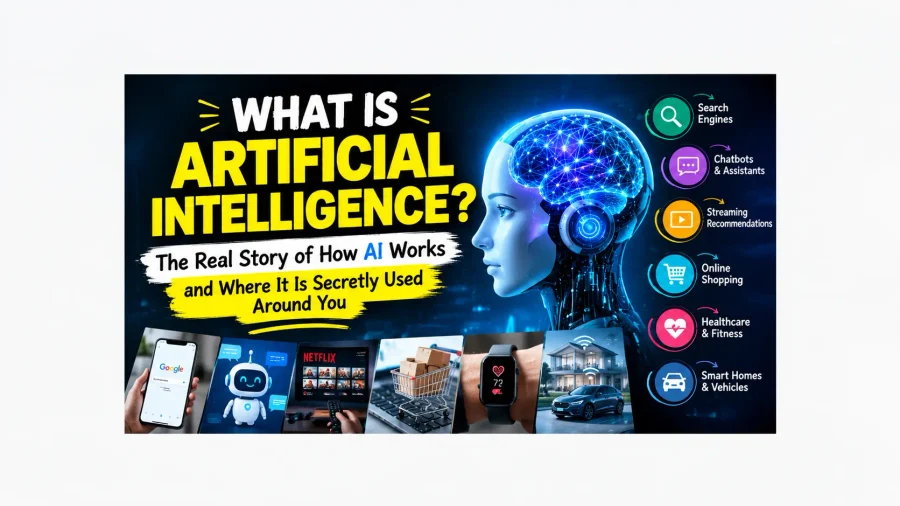

What is Artificial Intelligence? It’s one of the most searched questions of this decade, and yet most explanations online either sound too technical or too vague to actually make sense. In the simplest terms, Artificial Intelligence is the branch of computer science that trains machines to think, learn, and make decisions the way a human brain does — except at a speed and scale no human ever could. From the voice assistant on your phone to the recommendation feed on your favorite app, AI has quietly become part of almost everything you touch in a single day.
This article breaks down what is Artificial Intelligence in plain, human language, explains how AI actually works behind the scenes, and walks through the real-world places where artificial intelligence is already being used — often without people even realizing it.
What Is Artificial Intelligence in Simple Words
Artificial Intelligence in simple words means teaching a computer to do tasks that normally need human intelligence — things like recognizing a face in a photo, understanding spoken language, predicting what you’ll type next, or deciding the fastest route on a map. Instead of following one fixed set of instructions, an AI system studies large amounts of data, spots patterns in that data, and uses those patterns to make decisions or predictions on its own.
Think of it this way: a regular computer program only does exactly what it’s told, step by step. An AI system, on the other hand, is given examples and learns the rules itself — much like a child learning to recognize a dog after seeing enough pictures of dogs, rather than being handed a strict definition of one.
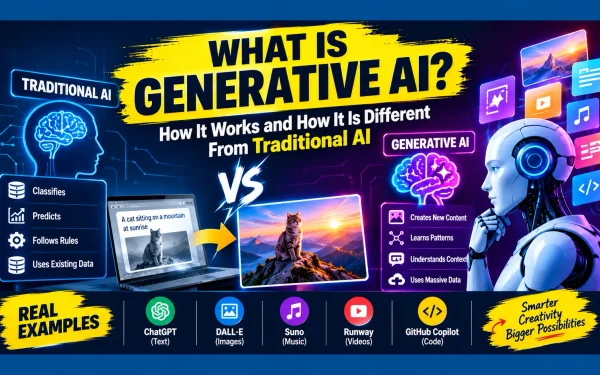
Generative AI: A Major Development in Artificial Intelligence
Artificial intelligence covers a broad range of technologies and applications, while generative AI focuses specifically on creating new content from learned patterns. Generative AI can produce text, images, video, audio and software code in response to user prompts.For a deeper explanation, read our guide on what generative AI is, how it works and how it differs from traditional AI.
Best Definition of Artificial Intelligence
The best definition of Artificial Intelligence widely accepted by computer scientists describes it as the simulation of human intelligence processes by machines, especially computer systems. These processes include three core things: learning (acquiring information and rules), reasoning (using those rules to reach conclusions), and self-correction (improving results over time based on feedback).
Put simply, AI is not a single piece of software — it’s an entire field of technology that includes machine learning, deep learning, natural language processing, computer vision, and robotics, all working toward the same goal of giving machines a form of decision-making ability.
What Is Artificial Intelligence With Examples
Artificial Intelligence examples are honestly everywhere once you start noticing them, even though most people don’t think of these tools as “AI” in daily life:
- Voice assistants like Siri, Alexa, and Google Assistant that understand and respond to spoken commands
- Netflix and YouTube recommendation systems that predict what you’ll want to watch next
- Google Maps and Uber calculating the fastest route in real time based on live traffic data
- Spam filters in Gmail that automatically detect and block unwanted emails
- Face unlock on smartphones that identifies your face in a fraction of a second
- Chatbots on shopping websites that answer customer questions instantly
- Autocorrect and predictive text on your keyboard that finishes your sentences
These small, everyday tools are proof that AI isn’t some distant, futuristic idea — it’s already woven into ordinary routines.
AI Chatbots as a Practical Application of AI
Artificial intelligence is now used in many everyday applications, including customer support, search, content creation and conversational tools. AI chatbots are one example of how AI can be used to understand user questions and provide responses through natural language. To understand how these systems work, read our detailed guide on what an AI chatbot is and how it works.
What Is Artificial Intelligence in Computer Science
AI in computer science refers to the specific subfield dedicated to building algorithms and systems capable of performing tasks that typically require human cognition. Inside a computer, this usually means feeding a program large datasets — text, images, numbers, or sound — and using mathematical models to find patterns within that data. Once trained, the computer can apply what it “learned” to brand-new data it has never seen before.
This is different from traditional computer programming, where a developer writes every single rule by hand. In AI-based computer systems, the machine builds its own internal rules by analyzing examples, which is why AI models tend to improve the more data they are trained on.
How AI Works: Step-by-Step
How AI works can be broken down into a fairly simple process, even though the underlying math is complex:
| Step | What Happens | Real-World Example |
|---|---|---|
| 1. Data Collection | Large amounts of raw data are gathered — text, images, numbers, or audio | Millions of photos labeled “cat” or “dog” |
| 2. Data Training | The AI model studies the data to identify patterns and relationships | The model learns what features define a cat’s face |
| 3. Model Building | An algorithm (often a neural network) is built to represent those learned patterns | A deep learning model is created for image recognition |
| 4. Testing | The trained model is tested on new, unseen data to check accuracy | The model is shown new photos it hasn’t seen before |
| 5. Prediction/Decision | The AI applies what it learned to make a decision or prediction | The model correctly labels a new photo as “cat” |
| 6. Feedback Loop | Errors are corrected, and the model keeps improving over time | The model gets better each time it’s retrained with more data |
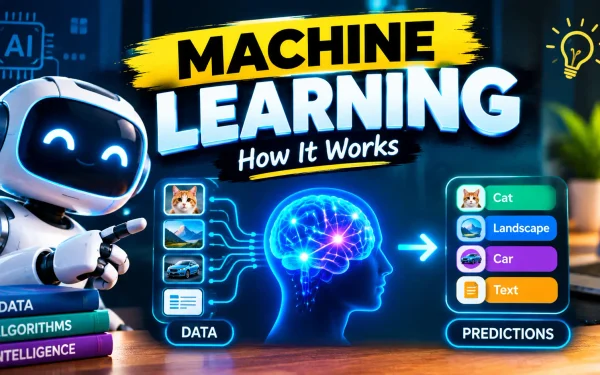
This cycle of learning, testing, and improving is what makes machine learning — the most common method used to build AI systems — so powerful. Rather than being manually reprogrammed, the system refines itself using fresh data and feedback.
Applications of Artificial Intelligence: Where Is AI Used
Applications of Artificial Intelligence now stretch across nearly every industry, and this is really where the technology’s impact becomes visible. Uses of Artificial Intelligence are no longer limited to tech companies — they’ve spread into healthcare, finance, transport, agriculture, education, and entertainment.
Uses of AI in daily life often go unnoticed simply because they work quietly in the background, powering things like fraud detection on your bank card or the auto-generated captions on a video.
10 Uses of Artificial Intelligence
| # | Industry | How AI Is Used |
|---|---|---|
| 1 | Healthcare | Detecting diseases early through medical image analysis and predicting patient risk |
| 2 | Finance | Detecting fraudulent transactions and powering algorithmic stock trading |
| 3 | Transportation | Enabling self-driving cars and optimizing delivery and traffic routes |
| 4 | E-commerce | Personalizing product recommendations and powering customer support chatbots |
| 5 | Agriculture | Monitoring crop health via drones and predicting the best harvest times |
| 6 | Education | Powering adaptive learning apps and automated grading systems |
| 7 | Entertainment | Recommending movies, music, and shows based on viewing habits |
| 8 | Manufacturing | Running predictive maintenance on machines to avoid costly breakdowns |
| 9 | Customer Service | Operating 24/7 chatbots and virtual assistants for instant support |
| 10 | Security | Powering facial recognition, surveillance analytics, and cybersecurity threat detection |
Advantages of Artificial Intelligence
Advantages of Artificial Intelligence go well beyond simple convenience. AI systems can process massive volumes of data far faster than any human team, work around the clock without fatigue, and reduce human error in repetitive or high-risk tasks. In healthcare, this can mean catching a disease earlier than a doctor might spot it manually. In finance, it can mean flagging a fraudulent transaction within milliseconds instead of days.
That said, AI isn’t without limitations — it depends heavily on the quality of data it’s trained on, it can inherit biases present in that data, and it still requires human oversight for judgment calls that involve ethics, context, or common sense. A balanced view of AI recognizes both its strengths and the areas where human decision-making still matters.
What Is an Artificial Intelligence Course
Artificial Intelligence course options have grown rapidly as demand for AI skills has increased across nearly every industry. These courses typically cover foundational topics like mathematics and statistics, programming languages such as Python, machine learning fundamentals, neural networks, and practical projects involving real datasets. They range from free beginner-level tutorials to full university degrees and professional certifications, making it possible for almost anyone — student or working professional — to start learning the basics of how AI systems are actually built.
Frequently Asked Questions
What is Artificial Intelligence in one sentence? Artificial Intelligence is the technology that enables machines to learn from data and perform tasks that would normally require human intelligence, such as recognizing images, understanding language, or making predictions.
What is Artificial Intelligence with examples? Common examples include voice assistants like Alexa and Siri, streaming recommendation systems on Netflix, GPS navigation apps, spam filters, and face-unlock features on smartphones.
What is the best definition of Artificial Intelligence? The most widely accepted definition describes AI as the simulation of human intelligence processes — learning, reasoning, and self-correction — by computer systems and machines.
What is Artificial Intelligence in simple words? In simple words, AI is when a computer learns from examples and data to make its own decisions, instead of only following instructions that a programmer has written by hand.
What is Artificial Intelligence in computer science? In computer science, AI refers to the field focused on building algorithms and systems that can perform tasks requiring human-like reasoning, using data-driven models rather than fixed, hand-coded rules.
What are the main uses of AI? AI is widely used in healthcare, finance, transportation, e-commerce, agriculture, education, entertainment, manufacturing, customer service, and security, among many other sectors.
What are the advantages of Artificial Intelligence? AI offers faster data processing, round-the-clock availability, reduced human error, and the ability to identify patterns in massive datasets that would take humans far longer to analyze manually.
Is there a good Artificial Intelligence course for beginners? Yes, many free and paid Artificial Intelligence courses are available online, ranging from beginner-friendly introductions to Python and machine learning, to advanced university-level programs in deep learning and neural networks.



3 Comments